$ cat bunnyshell.yaml
One File.
Every Stack. Zero Drift.
Define your entire stack in one file. Version-controlled.
Reproducible. Drift-free.
No credit card required
Used by engineering teams at






















$ cat how-it-works.md
How Bunnyshell works
Connect your repo
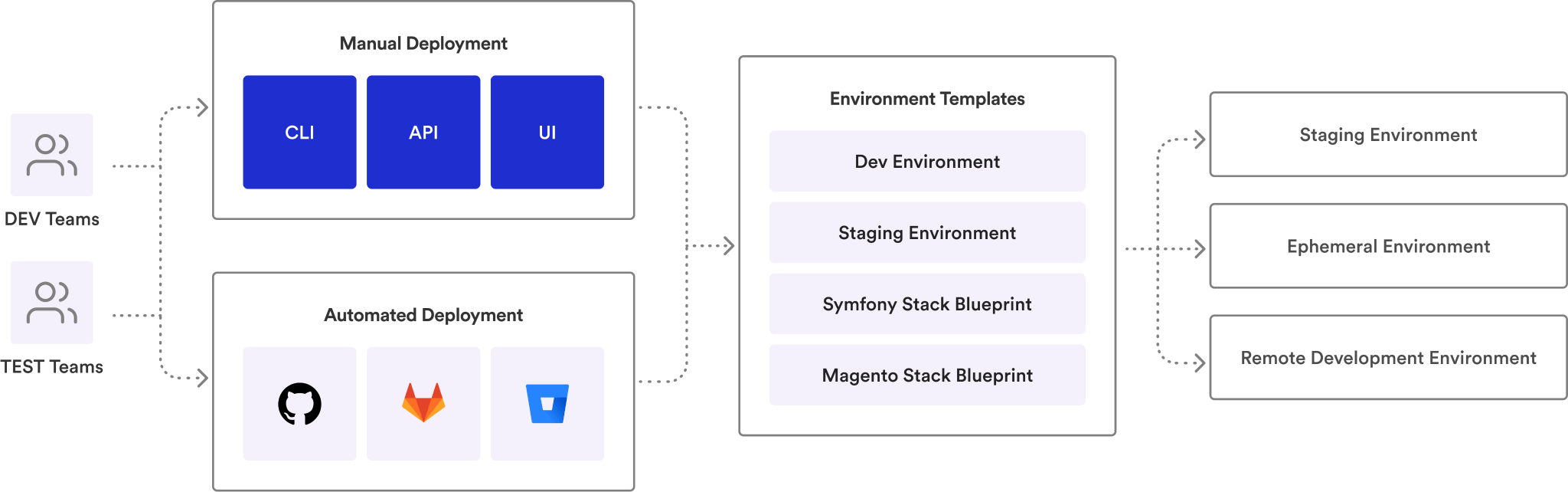
Link your GitHub, GitLab, or Bitbucket repository. Define your environment using Docker Compose, Helm, or Terraform — tools you already use.
 GitHub
 GitLab
 Bitbucket
 Docker
 Helm
Helm K8s
K8sOpen a pull request
Bunnyshell auto-provisions an isolated, full-stack environment for every PR. Share the preview URL with your team.
Merge and move on
Tests pass, code is reviewed, PR merges. The environment auto-destroys. No cleanup. No surprise cloud bills.
See it in action.
Define your first environment in under 30 minutes. Free trial — no credit card required.
Your Entire Stack,
In One YAML File.
Docker Compose services, Helm charts, Kubernetes manifests, Terraform modules — all defined in a single bunnyshell.yaml that lives in your repo. Push to Git and your environment rebuilds exactly as defined. Every time.
- ✓Declarative — describe the desired state, Bunnyshell handles the execution
- ✓Version-controlled — every change to your environment is a Git commit with full audit trail
- ✓Reproducible — same YAML, same environment. Dev, staging, production — identical
- ✓Composable — mix Docker Compose, Helm, Terraform, and K8s manifests in a single definition
7 Component Types.
One File.
Your stack isn't one thing. It's a frontend in Docker Compose, a backend in Helm, infrastructure in Terraform, and a worker running raw manifests. Bunnyshell handles all of them — in a single environment definition.
- ✓Docker Compose — auto-converted to Kubernetes. Health checks, volumes, cron jobs, ingress — all translated
- ✓Helm — deploy Helm charts with full lifecycle management. Custom values, rollback, atomic installs
- ✓Terraform — provision cloud resources as part of your environment. RDS, S3, Cloud SQL — anything Terraform manages
- ✓Kubernetes Manifests — apply raw K8s YAML directly. No abstraction overhead
Dependency
Orchestration.
Your API needs the database. Your worker needs the API. dependsOn declares the order. Bunnyshell builds a dependency graph, deploys independent components in parallel, and waits for dependencies before deploying downstream services.
- ✓Declarative ordering — dependsOn: [database, cache] and Bunnyshell does the rest
- ✓Parallel execution — components without dependencies deploy simultaneously
- ✓Cross-component references — {{ components.database.exported.DB_HOST }} wires services together
- ✓Cascading destroys — tear down in reverse dependency order. Clean, every time
Variables, Secrets
& Interpolation.
Twig-like expression engine with conditionals, filters, and cross-component references. Wire outputs from one component into another. Config adapts to every environment automatically — no hard-coded strings.
- ✓Twig-like expressions — filters, defaults, and conditionals for environment-specific behavior
- ✓Cross-component references — wire outputs from one component to inputs of another automatically
- ✓Secret variables — encrypted at rest, injected at deploy time. Never hard-coded
- ✓Variable Groups — share secrets across environments. Override per-env when you need to
Template Sync
& Drift Detection.
UI changes and YAML edits diverge over time. Template Sync detects the difference automatically and shows a side-by-side diff — reconcile or override in one click.
- ✓Drift detection — automatic comparison between environment state and YAML source of truth
- ✓Side-by-side diff editor — see exactly what changed, decide what to keep
- ✓One-click reconciliation — apply the template to bring the environment back in line
- ✓Audit trail — every change tracked in Git. Who changed what, when, and why
Built for every team member,
not just DevOps.
One file, one truth
One YAML file, one command, one environment. Every dependency version, every connection string — defined in code, not tribal knowledge.
Enforce standards in code
Define approved templates in Git. Every team gets compliant environments without tickets or runbooks.
Day-one productivity
Clone the repo, deploy from the template. A working environment in minutes — ready to contribute from day one.
Identical test environments
Same YAML, same environment. Dev, staging, QA — all built from the same definition. Reproducible by default.
Full visibility across environments
Version-controlled environments with template sync and drift detection. Know exactly what is running, everywhere.
Multi-stack, one definition
Docker Compose, Helm, Terraform, K8s manifests — all in one file. No more separate pipelines for each stack.
Same YAML. Same environment. Every time.
Define your stack, deploy, and see reproducible environments in action. Free trial, no credit card required. Free white-glove onboarding.
Teams that eliminated
environment drift.


“Manual tests on Argo CD PRs now take me seconds. When you review dozens of PRs a day, that's a game-changer.”


“Automatically created BunnyShell environment based on PRs, speeding up the entire task implementation process.”


“The automation and scalability that Bunnyshell provides complements the DigitalOcean platform, empowering developers to build amazing products.”


“Websites don't die anymore, sales keep growing sustained by state-of-the-art tech scalability. Customers send thank you cards.”

“From a release once in 2-4 weeks to multiple times per week, and nobody's stressed about it.”

“I can count on an integrated platform for managing our infrastructure — capabilities we don't have in-house, at a fraction of the cost.”

“I can do with Bunnyshell and a DevOps person what my clients are doing with 4 DevOps people.”

“Developers want convenience. They expect someone to translate their Docker Compose to the cloud. They're not going to rush to learn Kubernetes.”

“Bunnyshell was the only tool that handled our Helm + EKS setup without asking us to change everything.”

“60+ microservices. Bunnyshell deploys them in parallel and lets us control which ones come first.”
Enterprise-grade security.
Your data stays in your cloud.
Bunnyshell connects to YOUR Kubernetes cluster. Your code and data never leave your infrastructure. SOC 2, ISO 27001, and ISO 9001 compliant.



RBAC
Three-layer permission model: Policies, Resource Selectors, and Teams. Granular enough for enterprise.
SSO
Enterprise single sign-on. Integrate with your existing identity provider.
Network Isolation
Dedicated Kubernetes namespace per environment. Pods accessible only within their namespace.
Secrets Management
Environment variables and secrets handled securely. Never hard-coded, always encrypted.
IP Whitelisting
Restrict access to specific IP ranges. Control who can reach your environments.
Audit Logs
Full audit trail for every environment action. Who deployed what, when, and where.
Frequently asked
questions
Can’t find what you’re looking for? Talk to our team
It's a declarative configuration file that defines your entire environment — application services, databases, infrastructure, dependencies, variables, and hosts. Think of it as a docker-compose.yml that also handles Helm charts, Terraform modules, and Kubernetes manifests in a single file.
Define once. Deploy everywhere.
Write your bunnyshell.yaml and deploy reproducible environments in minutes. Free trial, no credit card required. Free white-glove onboarding.


