$ bns environments deploy --pr
Kill Shared Staging.
Every PR Gets Its Own.
Every pull request gets a full-stack, production-like environment in minutes. Auto-created on push, destroyed on merge. No staging contention. No DevOps tickets.
No credit card required
Used by engineering teams at






















$ cat how-it-works.md
How Bunnyshell works
Connect your repo
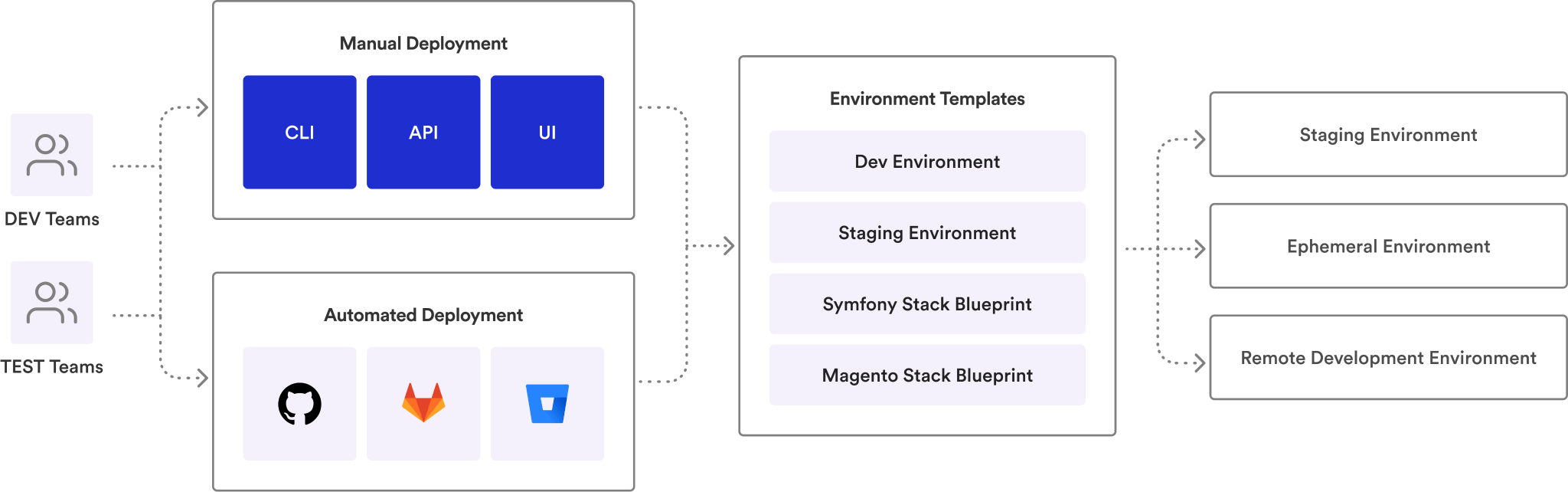
Link your GitHub, GitLab, or Bitbucket repository. Define your environment using Docker Compose, Helm, or Terraform — tools you already use.
 GitHub
 GitLab
 Bitbucket
 Docker
 Helm
Helm K8s
K8sOpen a pull request
Bunnyshell auto-provisions an isolated, full-stack environment for every PR. Share the preview URL with your team.
Merge and move on
Tests pass, code is reviewed, PR merges. The environment auto-destroys. No cleanup. No surprise cloud bills.
See it in action.
Deploy your first ephemeral environment in under 30 minutes. Free tier — no credit card required.
Auto-Deploy
on PR Open.
No clicking "deploy." No filing tickets. Open a pull request and your environment starts provisioning immediately. Every component — from your API to your database — builds and deploys in parallel.
- ✓Git-native trigger — GitHub, GitLab, and Azure DevOps webhooks fire automatically on PR open
- ✓Parallel builds — independent components build and deploy simultaneously, cutting provision time
- ✓Auto-update on push — push new commits and your environment updates in place. No redeploy needed
- ✓Git ChatOps — /bns:deploy, /bns:stop, /bns:start from PR comments for manual control
Full-Stack
Replication.
Not just frontend previews. Every environment includes your application, backend services, database with seeded data, and infrastructure — all replicated from production. Test real integrations, not mocked endpoints.
- ✓App + DB + infra — Docker Compose, Helm, and Terraform components in a single environment
- ✓Database cloning — native connectors for Neon, PlanetScale, Xata. Seed data automatically
- ✓Production parity — same container images, same networking, same configs. Catch bugs before production
- ✓7 component types — Docker Compose, Helm, K8s Manifests, Terraform, Custom Docker Image, Static App, Generic
Preview URLs &
Collaboration.
Every environment gets a unique, shareable URL — automatically posted to your pull request. QA reviews without setup. Product managers see features before merge. Stakeholders give feedback on real, running code.
- ✓Auto-posted URLs — Bunnyshell comments on your PR with environment URL and status
- ✓Per-component URLs — frontend, API docs, admin panel — each gets its own accessible endpoint
- ✓Custom domains — assign your own domain to any environment for client demos or external reviews
- ✓IP whitelisting — restrict access for sensitive applications. Secure by default

Auto-Destroy &
Lifecycle Management.
Environments that manage themselves. Merge a PR and the environment destroys itself. Leave for the night and it auto-sleeps. Come back in the morning and it wakes up. No forgotten resources. No surprise cloud bills.
- ✓Auto-destroy on merge — PR merged or closed? Environment gone. Zero manual cleanup
- ✓Auto-sleep schedules — stop at 8 PM, start at 8 AM. Custom schedules per environment
- ✓Per-environment cost tracking — Kubecost integration shows what each environment costs per hour
- ✓Termination protection — lock critical demo environments against accidental deletion
Your entire engineering org
ships faster.
No more staging queues
Open a PR, get your own environment in minutes. Code, test, and iterate without stepping on anyone else's work.
Self-serve UAT
Self-serve UAT environments for every feature branch. No more "can I get a staging slot?" Test in isolation, file bugs with a link to the exact environment.
Zero environment tickets
Stop fielding "I need an environment" tickets. Developers self-serve from templates you control. Enforce standards without being the bottleneck.
Ship faster, measure everything
Faster releases with fewer regressions. Track deployment frequency and cycle time with built-in DORA metrics. See ROI in the first week.
Review features before merge
Every PR gets a shareable URL. Click, review, give feedback — no setup, no VPN, no waiting for deploys. Ship with confidence.
Demo any branch, anytime
Spin up isolated demo environments for client presentations. Show real, running code — not slides. Tear down when done.
Deploy your first ephemeral environment today.
Free tier includes 5 environments. No credit card required. Free white-glove onboarding.
Teams that replaced staging
with ephemeral environments.


“Manual tests on Argo CD PRs now take me seconds. When you review dozens of PRs a day, that's a game-changer.”


“Automatically created BunnyShell environment based on PRs, speeding up the entire task implementation process.”


“The automation and scalability that Bunnyshell provides complements the DigitalOcean platform, empowering developers to build amazing products.”


“Websites don't die anymore, sales keep growing sustained by state-of-the-art tech scalability. Customers send thank you cards.”

“From a release once in 2-4 weeks to multiple times per week, and nobody's stressed about it.”

“I can count on an integrated platform for managing our infrastructure — capabilities we don't have in-house, at a fraction of the cost.”

“I can do with Bunnyshell and a DevOps person what my clients are doing with 4 DevOps people.”

“Developers want convenience. They expect someone to translate their Docker Compose to the cloud. They're not going to rush to learn Kubernetes.”

“Bunnyshell was the only tool that handled our Helm + EKS setup without asking us to change everything.”

“60+ microservices. Bunnyshell deploys them in parallel and lets us control which ones come first.”
Enterprise-grade security.
Your data stays in your cloud.
Bunnyshell connects to YOUR Kubernetes cluster. Your code and data never leave your infrastructure. SOC 2, ISO 27001, and ISO 9001 compliant.



RBAC
Three-layer permission model: Policies, Resource Selectors, and Teams. Granular enough for enterprise.
SSO
Enterprise single sign-on. Integrate with your existing identity provider.
Network Isolation
Dedicated Kubernetes namespace per environment. Pods accessible only within their namespace.
Secrets Management
Environment variables and secrets handled securely. Never hard-coded, always encrypted.
IP Whitelisting
Restrict access to specific IP ranges. Control who can reach your environments.
Audit Logs
Full audit trail for every environment action. Who deployed what, when, and where.
Frequently asked
questions
Can’t find what you’re looking for? Talk to our team
An ephemeral environment is a full-stack, isolated copy of your application — frontend, backend, database, and infrastructure — that is automatically created for a specific pull request and destroyed when the PR is merged or closed. It is not a preview deployment or a frontend-only snapshot. It replicates your production stack.
Your staging bottleneck ends today.
Start free \u2014 deploy your first ephemeral environment in minutes. Free tier includes 5 environments. No credit card required. Free white-glove onboarding.


