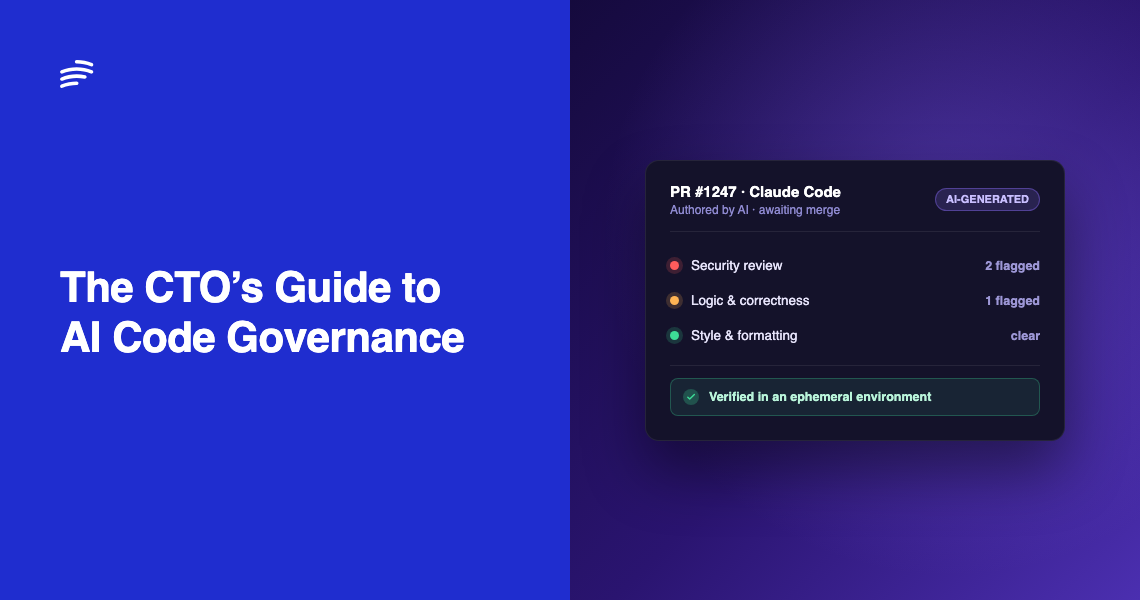
The CTO’s Guide to AI Code Governance
Most conversations about "AI code quality" and "AI code review" are actually about testing: does the code work, does it pass CI, does it introduce bugs. That's a real problem — CodeRabbit's 2026 analysis of 470 open-source pull requests found AI-co-authored PRs carry 1.7x more issues than human-only PRs (10.83 vs. 6.45 issues per PR), with security vulnerabilities up to 2.74x higher and logic/correctness issues 75% more common. But quality is the symptom. Governance is the thing CTOs are actually missing, and it's a different problem: who wrote this, what did it cost, and can you prove any of it when someone above you asks.
The problem isn't code quality. It's that nobody owns the question.
Talk to engineering leaders who are a year or more into heavy AI coding tool adoption, and the pain points aren't "the code is buggy." They're structural:
- Spend is unattributable. One CTO asked the group how they track Cursor, Copilot, and Claude Code spend separately from general AI/API spend — not as a nice-to-have, but because he genuinely couldn't isolate it. The answers ranged from "we built an AI gateway" to "we estimate from the total bill," which tells you how immature this is even among engaged practitioners.
- Board reporting has no baseline. Another thread: a CTO with "data, models, and tool budgets" walks into a board session and can't quantify what AI actually delivered. All the ingredients, no numbers. The group's best answer was to fall back on pre-AI productivity metrics (tickets closed, features shipped, cycle time) and compare before/after — because nobody had built anything AI-specific.
- Shadow IT is the default coping mechanism. When Claude Enterprise seat pricing came in roughly double what forecast calculators predicted, one CTO's workaround was running multiple Claude Teams accounts under different domains to dodge the seat cap — a purchasing decision made ad hoc, outside procurement, because the alternative was blocking developers.
- Standards live in someone's head, not in a system. The teams doing this well are maintaining org-wide context files (CLAUDE.md-style) that encode coding standards and get fed back from human code review themes — but that's a handful of teams building it manually, not a governed process most orgs have.
None of that is "is the AI-generated function correct." It's operational governance, and right now it's running on Slack threads and tribal knowledge instead of policy.
"Review it like you'd review a junior dev" doesn't scale to the volume
The default advice — treat AI output like a junior engineer's PR, review it carefully — is correct in spirit and wrong in practice. A junior developer opens a handful of PRs a week. Claude Code, at the scale Anthropic itself is now designing around, pushes PR volume that outstrips normal review capacity — Anthropic's own product lead described the problem in exactly those terms: too many pull requests, not enough reviewer bandwidth to check them properly.
It's why AI code review has quietly become its own product category — Anthropic's Code Review, CodeRabbit, and Secure Code Warrior's Trust Agent AI are all responses to the same volume problem, not competing bets on the same feature.
And the issues aren't evenly distributed across categories, so "review carefully" without knowing what to look for wastes reviewer attention on the wrong things:
| Issue category | AI-generated code vs. human-written |
|---|---|
| Security vulnerabilities | Up to 2.74x more common |
| Logic and correctness issues | 75% more common |
| Readability issues | ~3x more common |
| Formatting problems | ~2.66x more common |
| Error handling gaps | ~2x more common |
| Overall issues per PR | 1.7x more (10.83 vs. 6.45) |
Source: CodeRabbit, State of AI vs. Human Code Generation Report, 2026.
Security and logic errors — the categories that actually cause incidents — are exactly where AI code diverges most from human code. That's a case for systematic verification, not just "look harder."
The security data behind the urgency
CodeRabbit's numbers are about code quality broadly. The security-specific research is worse, and it's worth sitting with before deciding governance can wait a quarter:
- Veracode's 2025 GenAI Code Security Report tested over 100 LLMs across 80 coding tasks and found 45% of AI-generated code samples contained at least one security vulnerability — a rate that hit 72% for Java specifically, the riskiest language in the study.
- NYU Tandon's research on GitHub Copilot generated 1,689 programs from 89 realistic coding scenarios and found roughly 40% contained exploitable vulnerabilities — foundational research that later, larger studies have kept reconfirming rather than overturning.
- GitHub's own Octoverse 2025 report found Broken Access Control has overtaken Injection as the most common vulnerability type, appearing in over 151,000 repositories — the exact category that shows up when access-control logic gets generated without full system context.
- IBM's 2025 Cost of a Data Breach Report put the global average breach cost at $4.44 million, and separately found 97% of organizations that experienced an AI-related security incident lacked proper AI access controls, while 63% had no AI governance policy at all. High shadow-AI usage alone added $670,000 to the average breach cost.
None of this is an argument against AI coding tools. It's an argument that the absence of a governance layer isn't a neutral default — it's the condition under which these numbers get generated. DORA's 2024 research put it plainly: AI adoption measurably increases individual developer productivity, and separately, measurably decreases software delivery stability. Those are two different curves moving in opposite directions, and governance is what's supposed to sit between them.
Four pillars of AI code governance
Strip away the tooling pitches and a governance framework for AI-generated code comes down to four things a CTO needs to be able to answer, at any time, for any PR:
1. Attribution — who (or what) wrote this, and is it labeled
The market is already moving here: Secure Code Warrior launched a "Trust Agent AI" product in early 2026 specifically to make AI's influence in a codebase "visible, attributable, and enforceable at the point of commit." Anthropic's own Code Review tool exists for the same reason — labeling severity and flagging what a human needs to look at, because unattributed AI output in a PR stream is a liability nobody can query later. If you can't answer "which parts of this service were AI-generated" during an incident postmortem or a security audit, you don't have attribution — you have a guess.
In practice, this means every PR carries a label — human-authored, AI-assisted, or AI-generated — set automatically by the tool that opened it, not typed in by a developer who might forget. It means that label survives into your deployment logs and your incident tooling, so when something breaks at 2am, the on-call engineer isn't reconstructing authorship from git blame and memory. And it means the label is queryable later: "show me every production incident in the last quarter traced to AI-generated code" should be a report you can run, not a research project.
2. Verification — nothing ships without running, for real, before merge
This is the layer most teams skip, because it's the expensive one to build yourself. Linting and unit tests catch syntax problems; they don't catch the logic and integration errors that CodeRabbit's data shows are 75% more common in AI code. The only way to catch those before production is to actually run the full stack — application, database, dependent services — against a PR, not just the diff.
This is the argument for ephemeral, full-stack preview environments as a governance control, not just a productivity feature: every AI-generated PR gets a real, isolated, production-parity environment automatically, QA and reviewers test against the actual running system, and the environment is destroyed on merge. It's the difference between "the code compiles and passes mocked tests" and "the code actually works when it talks to the real database." See how per-PR environments work for microservices, and how teams run AI coding agents in isolated sandboxes before code ever reaches a shared branch.
The reason this belongs under governance and not just "good testing practice" is enforcement. A testing best practice is something a team can choose to skip under deadline pressure. A governance control is something the pipeline enforces regardless of who's asking for an exception — no environment, no merge, full stop. Given that Broken Access Control is now the single most common vulnerability class on GitHub, and that class specifically requires a running system with real auth flows to catch (a unit test on an isolated function doesn't exercise a permission boundary between two services), the verification gate isn't optional infrastructure. It's the control that would have caught the category of bug most likely to be sitting in your codebase right now.
3. Spend governance — cost has to be attributable before it's controllable
The AI Gateway pattern is worth taking seriously: teams that have solved cost visibility are routing Cursor, Copilot, Claude Code, and product-facing LLM calls through a gateway that tags spend by source, team, and user — treating it as "observability for LLMs." Without that, you're negotiating enterprise seat pricing (which, by multiple accounts, regularly lands at double what self-serve calculators predict) with no data on what you're actually getting per dollar. Spend governance isn't a finance problem bolted onto engineering — it's the same discipline as attribution, applied to cost instead of code.
There's a second, less obvious reason this matters: IBM's 2025 breach research found that high shadow-AI usage alone added $670,000 to the average breach cost. Ungoverned spend and ungoverned tool usage are usually the same underlying failure — developers routing around procurement because the sanctioned path is slower or capped, using personal accounts or unapproved tools to keep working. Attribute spend properly and you don't just get a budget number; you get visibility into which tools are actually in use across the org, which is the same visibility a security review needs.
4. Standards as a system, not tribal knowledge
The teams ahead of the curve treat AI coding standards as a living artifact: an org-wide context file that captures your actual conventions, gets updated when human reviewers catch the same class of mistake twice, and gets fed to every developer's AI tool the same way. That's the AI-era equivalent of a linter config — except most orgs haven't built it, so every developer's AI output reflects whatever that developer happened to prompt for, not a shared standard.
The mechanics are simpler than they sound: a CLAUDE.md or equivalent context file at the repo root, version-controlled like any other config, reviewed in the same PRs that touch the code it governs. The discipline that matters isn't the file format — it's the feedback loop. When a human reviewer flags the same category of mistake for the third time — missing error handling on an external call, a permission check skipped, a naming convention ignored — that correction goes into the context file, not just the PR comment. Without that loop, every developer's AI tool relearns the same lessons from zero, forever, one PR at a time.
Writing an actual governance policy
Most of what gets called an "AI governance policy" is a Slack message pinned to a channel, or a paragraph in an onboarding doc nobody rereads. A policy that actually functions as a control — something you could hand to an auditor or cite in an incident postmortem — covers five things, each mapped to one of the pillars above:
| Section | What it specifies |
|---|---|
| Scope | Which AI coding tools are approved for use, and whether that list is enforced technically (SSO-gated, network-allow-listed) or just documented |
| Attribution requirement | How AI-assisted or AI-generated code gets labeled, at what stage (commit, PR, deploy), and who can query that label later |
| Verification gate | What has to pass before an AI-authored PR can merge — specifically naming a running-environment requirement, not just CI checks on the diff |
| Spend controls | Budget ceilings per team or tool, who can approve exceptions, and where spend is tracked (the gateway or billing source of record) |
| Incident response | What changes about a postmortem when the root-cause code was AI-generated — typically nothing procedurally, but the attribution data has to be available to whoever runs it |
None of this needs to be long. A one-page policy that's actually enforced by tooling beats a ten-page policy that's aspirational. The test worth applying to a draft: could you point to the specific control — the gate, the log, the label — that would have caught last quarter's closest call, if you had one? If the answer is "we'd have to check manually," the policy is a document, not a control yet.
A practical checklist
If you're building this from zero, here's the order that matches how the pain actually shows up:
- Attribute spend first. Route AI coding tool usage through a gateway or tagged billing source before you try to measure ROI — you can't report what you can't isolate.
- Require a running environment before merge, not just green CI. Green CI on mocked tests is not verification. A full-stack preview environment per PR is.
- Write down your AI coding standards once, then enforce them via context files, not code review comments repeated forever.
- Track logic and security issues separately from style issues in whatever review tooling you use — they're the categories where AI code actually diverges from human code, and where incidents come from.
- Build one board-ready metric now, even a rough one: PRs shipped per engineer, cycle time, or defect rate, measured before and after AI adoption. You will be asked for this. Better to have an imperfect answer than none.
- Put an audit trail under all of it — who deployed what, when, from which environment — so governance isn't a claim, it's a log you can pull.
Common objections
"This will slow down the velocity gains AI gave us." The verification gate adds minutes to a merge, not days — a provisioned environment and an automated test run, not a manual review cycle bolted on top. Compare that to the alternative: DORA's 2024 State of DevOps research already found AI adoption increasing individual productivity while decreasing delivery stability at the same time — the velocity gain is real, and so is the stability cost, and governance is what's supposed to let you keep the first without eating the second at 2am during an incident.
"Our AI vendor says their output is safe." Every vendor cited in this piece — Anthropic included — has independently concluded the opposite, which is why they're shipping review and governance products. Take that as a market signal, not a contradiction: the vendors closest to the problem are the ones building the controls, because "the model is good" and "the output needs verification" aren't in tension.
"We already have branch protection rules, isn't that enough?" Branch protection enforces process — required reviewers, passing CI — not verification against a real environment. A branch-protected PR with a green CI check and a rubber-stamp review still ships whatever CodeRabbit's and Veracode's data says is sitting in it. Protection rules are necessary and not sufficient.
"We're too small for a formal policy." The five-section policy above fits on one page and mostly reuses tooling you likely already have — CI, a deploy pipeline, whatever you use for billing. The size of the org changes how much process wraps around the policy, not whether the underlying controls (attribution, verification, spend, standards, audit trail) are worth having.
Where the verification layer fits
Bunnyshell's role in this framework is narrow and specific: it's the environment layer that makes step 2 and step 6 real instead of aspirational. Every pull request — AI-written or not — gets a full-stack, production-parity environment automatically, torn down on merge. That environment is where "does this actually work" gets answered before code reaches shared staging or production, and every action on it is logged in a full audit trail: who deployed what, when, from where.
For teams already past the "do we even have controls" stage, that sits alongside enterprise-grade access controls: SOC 2 Type II, ISO 27001, and ISO 9001 certification, a bring-your-own-cloud model so code and data never leave your infrastructure, three-layer RBAC (Policies, Resource Selectors, Teams), SSO via SAML/OIDC, and DORA-aligned engineering metrics for the board-reporting problem above. See what this looks like for engineering leaders or the full enterprise security and compliance details.
FAQ
Who is accountable when AI-generated code causes a production incident? The engineer who merged it — same as any other code. Attribution tooling and environment audit trails don't shift accountability off the reviewer; they give the reviewer (and the postmortem) something concrete to point to instead of "the AI wrote it."
Does AI code review need to work differently than human code review? Not differently in process — but weighted differently in attention. The data shows AI code fails more often on logic, security, and error handling than on style or syntax. Point review time there.
Is a full-stack preview environment overkill for most AI-generated PRs? For anything touching more than one service, a database, or an external dependency — no. That's exactly where mocked tests miss the integration bugs CodeRabbit's data shows are most common in AI code, and where "it passed CI" and "it actually works" diverge.
How do we get board-level ROI numbers if we haven't tracked anything yet? Start now with what you have: PRs or tickets shipped per engineer, cycle time, and defect/incident rate, using your last full quarter before heavy AI adoption as the baseline. Imperfect but real beats "we don't have numbers."
What should an AI code governance policy actually contain? Five sections mapped to the pillars above: scope (which tools are approved), attribution (how AI-authored code gets labeled and by whom it's queryable), a verification gate (what must pass before merge, specifically including a real running environment), spend controls (budget ceilings and where spend is tracked), and incident response (how attribution data gets pulled into a postmortem). One page, enforced by tooling, beats ten pages that are aspirational.
Does branch protection or required code review already cover this? No — those enforce process (a human looked at it, CI passed) not verification against a real, running environment. A protected branch with a green check and a quick approval still ships whatever security and logic issues were in the diff; protection rules and verification gates are complementary controls, not substitutes for each other.
Give every AI-generated PR a real place to run.
Full-stack, production-parity environments per pull request — automatic, audited, destroyed on merge. See how teams verify AI-written code before it ships.