Environment Drift Is Why Your Staging Tests Pass But Production Breaks
Your staging environment used to match production. That was true on day one. Six months, a dozen hotfixes, and three "quick manual changes to unblock a demo" later, it doesn't — and nobody decided that on purpose. This is environment drift, and it's the reason a green test suite in staging tells you less than you think it does.
What Environment Drift Actually Is
Environment drift is what happens when infrastructure or configuration in one environment gradually diverges from another over time, without anyone making a single deliberate decision to make them different. It typically results from manual updates, ad-hoc fixes, or unmanaged changes made outside your automated or version-controlled deployment process.
The word that matters most in that definition is gradually. Nobody sits down and decides "staging will now be meaningfully different from production." It happens one small, individually reasonable change at a time: someone bumps a timeout in staging to unblock a slow test run and forgets to bump it in the deployment manifest. Someone adds an environment variable directly to a running container to test something, and it never makes it into version control. Someone rotates a secret in production during an incident and staging quietly keeps the old one. None of these decisions looks dangerous in isolation. The accumulation is what kills you.
Industry analysis puts misconfiguration behind roughly 30-60% of deployment failures — meaning a large share of incidents that look, at first glance, like application bugs are actually environment drift wearing a bug's clothing. The code was fine. The environment underneath it wasn't what anyone thought it was.
The Six Root Causes
Configuration drift isn't one problem, it's six related ones that compound:
- Manual changes and human error. An engineer makes an ad-hoc fix directly on a running environment, under time pressure, without updating the source of truth. This is the single most common cause, and it's rarely malicious or careless — it's usually someone doing exactly what the moment demanded, with no time to also do configuration hygiene.
- Inconsistent deployment processes. Staging gets deployed one way (maybe a manual script someone wrote two years ago), production another (maybe a proper CI/CD pipeline). Any difference in how something is deployed is a difference waiting to cause a what.
- Dependencies on external systems that change independently. A third-party API changes its behavior, a managed database service rotates a default setting, a CDN updates its caching rules — and it hits one environment before (or instead of) the other.
- Genuine environment differences. Dev, staging, and production are rarely identical in scale, region, or provider configuration, and some of those differences are real and unavoidable — the problem is when nobody tracks which differences are intentional versus accidental.
- Lack of version control for configuration. If your application code is in Git but your environment variables, feature flags, and infrastructure settings aren't, you have no way to know what changed, when, or why — and no way to reliably revert it.
- Poor documentation of intended state. Even teams with decent practices often don't have a clear, current record of what staging is supposed to look like, which means nobody can tell drift has happened until something breaks.
Notice that none of these six causes is "someone was careless." They're all structural: they happen to disciplined teams too, because a long-lived environment that gets touched by multiple people over months is a system that accumulates undocumented state by default. The fix isn't better discipline — it's an architecture that doesn't depend on discipline to stay in sync.
What Actually Drifts, Concretely
"Configuration drift" sounds abstract until you list what actually goes wrong in practice. The recurring offenders:
| What Drifts | How It Breaks Things |
|---|---|
| Environment variables | A new variable is added for a feature and rolled out to production but never backfilled into staging — staging tests the old code path indefinitely |
| Secrets & API keys | Rotated in one environment during an incident, silently stale in another until something using the old value starts failing |
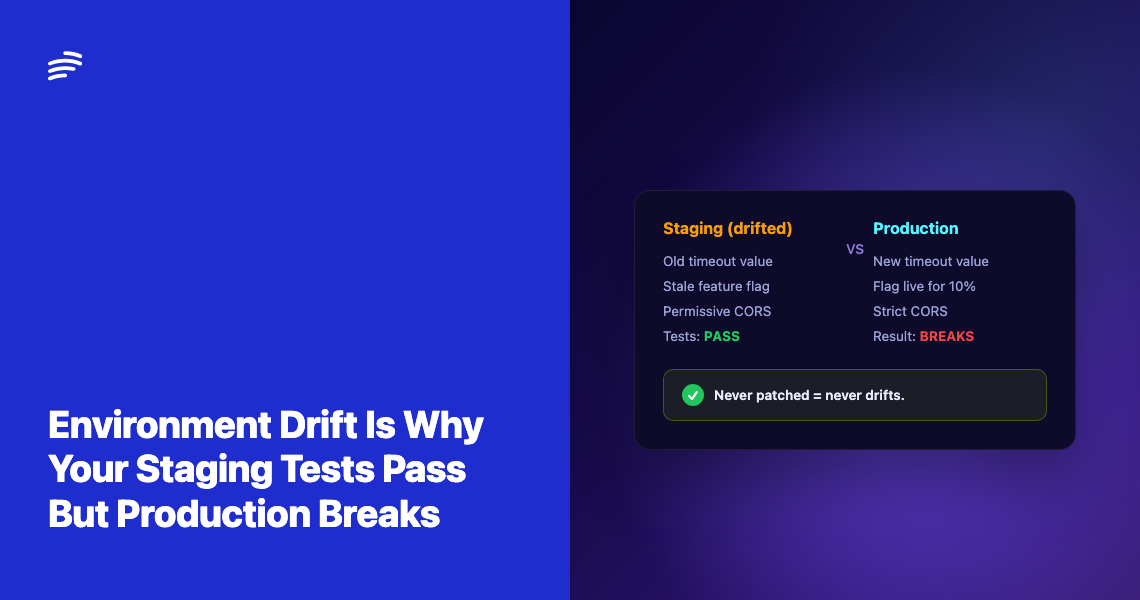
| Feature flags | A flag is flipped in production for a gradual rollout, and staging never reflects the flag's real-world state, so nobody tests the actual configuration users see |
| OAuth redirect URIs / auth settings | A domain or callback URL changes and one environment's auth provider config isn't updated to match — tests pass with a mocked auth flow that production doesn't use |
| CORS rules | Localhost/staging domains are allowlisted permissively; production is (correctly) strict — so a CORS bug never surfaces until prod |
| Database connection strings & pooling | Different pool sizes or timeout settings mean a query pattern that's fine in staging saturates connections under production load |
| Queue & timeout configuration | Retry counts, timeout thresholds, and queue depths differ just enough to change failure behavior under real traffic patterns |
Every single one of these is invisible to your test suite, because your test suite is testing application logic, not environment fidelity. A test can pass perfectly while asserting behavior against a version of the world that production doesn't actually match.
The Cost of Drift Isn't the Bug — It's the Time to Diagnose It
The most expensive part of environment drift usually isn't the incident itself. It's the hour (or six) spent figuring out why a change that passed every test in staging is failing in production, when the code is provably identical in both places.
The typical drift-diagnosis story goes like this: a change ships, something breaks in production, and the on-call engineer's first assumption is a code bug — because the tests passed, so the code "should" be fine. They spend time reading stack traces, adding logging, maybe reverting and re-deploying to confirm. Eventually, usually well into the incident, someone thinks to diff the actual running configuration between staging and production, and finds an environment variable that's been different for three months, or a connection pool setting nobody remembers changing, or a feature flag that's been in a different state in each environment since a rollout that finished in production but was never mirrored in staging.
That diagnostic path is expensive specifically because the default assumption — "the tests passed, so it's an environment problem, not a code problem" — is the last thing anyone checks, not the first. Teams debug the code for hours before they debug the environment, because debugging code is what tooling, training, and habit all point them toward. Environment drift has comparatively little tooling pointed at it by default, which is exactly why it survives so long before anyone notices.
This Isn't a Hypothetical — Real Engineers Hit This Constantly
It's easy to read a list of causes and nod along abstractly. It's more useful to see the exact language real engineers use when they hit this, because it tells you the pain is universal, not specific to badly-run teams.
One engineer, thinking through this exact problem on Reddit, put it plainly:
"Been thinking maybe the root cause of so many prod-only bugs is that our dev environments are too different from production. We run things locally with ideal data, low traffic, and maybe even different OS / dependency versions. But prod is messy as everyone knows this. We probably need to invest more in making staging or local setups mimic prod more closely." — r/devops
And it's not just teams running homegrown setups. A verified G2 review of Qovery — a commercial environment platform, not a DIY solution — from a customer identified as Kyle F. names the exact same problem as an ongoing challenge even with tooling in place: "Keeping lower environments aligned with production can be a complicated task." Buying a platform reduces the frequency of drift-causing manual changes. It doesn't eliminate the underlying dynamic unless the platform's architecture specifically prevents environments from being long-lived, patchable things in the first place.
Why Long-Lived Staging Environments Always Drift Eventually
Here's the structural reason drift is nearly universal rather than a sign of a poorly-run team: a traditional staging environment is a pet, not cattle — a single, long-lived server or cluster that gets provisioned once and then modified in place, indefinitely, by however many engineers touch it over its lifetime.
Every pet accumulates history. Every manual SSH session to "just quickly fix" something, every environment variable added directly through a cloud console instead of through Terraform, every dependency upgraded in staging to test something and never upgraded (or downgraded back) — all of it becomes part of that environment's undocumented, unversioned state. Nobody can fully reconstruct how a two-year-old staging environment got to its current configuration, because that configuration was never defined once; it was accumulated.
This is exactly why the "24. Ephemeral Environments vs Shared Staging" comparison keeps surfacing across engineering orgs: the problem was never really about whether staging exists, it's about whether staging is a persistent thing that can accumulate undocumented changes, or a definition that gets re-materialized fresh every time.
A Worked Example: How One "Quick Fix" Becomes a Production Incident
Drift rarely announces itself. It's worth walking through a realistic, composite version of how it actually happens, because the individual steps are so small that no single one looks like a mistake.
Week 1: A payment provider's API starts rate-limiting staging traffic more aggressively than usual — unrelated to your app, just a change on their end. An engineer bumps the retry timeout in staging's environment configuration directly, through the cloud provider's console, to get a demo working before a customer call. It works. The demo goes fine. Nobody updates the Terraform module that's supposed to define that value, because there's no time pressure to do it "properly" once the immediate problem is solved.
Week 6: A different engineer, working on an unrelated feature, adds a new feature flag to gradually roll out a checkout change. It's flipped on for 10% of production traffic. Staging's flag configuration was cloned from production weeks ago and never re-synced, so staging is still running the pre-flag code path entirely — the new logic is never exercised there at all.
Week 14: The checkout change is fully rolled out in production. QA signs off in staging, because staging's tests — running against the old, unflagged code path and the old retry timeout — all pass. They always pass; that part of the system hasn't meaningfully changed from staging's point of view.
Week 15: Production traffic hits the actual combination of the new checkout flow and the tighter payment-provider rate limits that staging's bumped timeout was quietly masking. Checkout starts failing under load. The on-call engineer pulls up the (green) staging test results, confirms the code "should" work, and spends the next four hours debugging application logic before someone finally diffs the environment configuration and finds two separate, unrelated changes that had each seemed too small to document three months apart.
Nothing in this story involves a bad engineer or a reckless decision. Every step was locally reasonable. That's the point: drift isn't a discipline failure, it's what happens by default to any environment that persists long enough for multiple people to touch it under time pressure.
The Structural Fix: Environments That Can't Drift Because They're Never Patched
The practices that reduce drift in a long-lived environment — Infrastructure as Code, drift-detection tools like Spacelift or AWS Config, GitOps workflows, configuration schema validation — are all genuinely useful, and worth implementing regardless. But they share a common limitation: they detect and reconcile drift after the fact. Someone (or something) has to notice the environment has diverged and correct it, on an ongoing basis, forever, as long as that environment exists.
There's a structurally different approach: make the environment itself ephemeral, so there's never a persistent thing for drift to accumulate in.
When a preview environment is created fresh for every pull request — deployed directly from your bunnyshell.yaml definition, your Helm charts, or your Docker Compose file, exactly as they exist in version control at that moment — there is no multi-month-old server carrying six months of undocumented manual changes. The environment either matches its definition exactly, because it was built from that definition minutes ago, or it doesn't exist yet. Drift has nowhere to live.
This doesn't mean drift detection tools become useless — production itself is still a long-lived environment, and IaC discipline still matters there. But it does mean the environment your tests actually validate against — staging, or its per-PR replacement — stops being the kind of thing that silently diverges over time. You get environment parity by construction, not by discipline and vigilance sustained indefinitely.
Environments That Can't Accumulate Drift
Bunnyshell rebuilds every environment from your Helm, Docker Compose, or Terraform definitions each time — no persistent server to patch, nothing for drift to hide in.
Why Drift Gets Worse as Change Velocity Increases
Drift accumulates as a function of two things: how long an environment persists, and how many changes get applied to it over that lifetime. Both variables are moving in the wrong direction industry-wide right now. As covered in AI Writes Code in Minutes, Your Team Waits Days for Staging, 2026 telemetry from CircleCI and Faros AI shows feature-branch and PR volume rising 40-60% at many organizations adopting AI coding tools. Every one of those additional pull requests is a chance for someone to make a small, undocumented, environment-specific tweak to get a test passing under time pressure — which is precisely the mechanism behind driver #1 in the causes list above.
In other words, the same forces increasing pressure on your staging environment's capacity are simultaneously increasing pressure on its fidelity. More PRs racing through a shared, long-lived staging environment doesn't just mean longer queues — it means more hands quietly touching that environment's configuration under deadline pressure, which means faster drift accumulation. The two problems compound each other, and neither is fixed by throwing more compute at CI.
A Practical Drift-Prevention Checklist
For environments you can't yet make fully ephemeral — production chief among them — the standard mitigation practices still matter, and each is worth doing properly rather than as a checkbox:
- Put every piece of configuration in version control. Environment variables, feature flag defaults, infrastructure definitions — all of it. If it's not in Git, you have no diff, no history, and no way to answer "what changed, and when?" when an incident starts. This is the single highest-leverage practice on this list, because every other practice depends on there being a source of truth to check against.
- Validate configuration schema at startup, not just at deploy time. A missing or malformed environment variable should fail loudly the moment a service starts, not silently degrade behavior three requests later in a way that looks like a logic bug. Startup-time validation turns a mystery into an immediate, readable error message.
- Centralize secret management through your cloud provider's secret manager (AWS Secrets Manager, GCP Secret Manager, Azure Key Vault) rather than environment-specific
.envfiles copied and modified independently. Rotation then happens once, in one place, and propagates everywhere automatically instead of requiring someone to remember every environment that needs the update. - Run continuous drift detection — Spacelift, AWS Config, Azure Policy, or your IaC tool's own plan/diff step — against any environment that remains long-lived, and treat detected drift as an incident with an owner and a deadline, not a backlog item that ages indefinitely.
- Enforce identical deployment mechanisms across every environment. If production deploys via a proper CI/CD pipeline and staging deploys via a script someone wrote two years ago and occasionally runs by hand, that asymmetry alone guarantees eventual divergence — not because the script is bad, but because it's a second, independently-maintained path to the same outcome.
- Document intended state explicitly, and treat that documentation as a diffable, version-controlled artifact — a Terraform module, a Helm values file, a
bunnyshell.yaml— not a wiki page that goes stale the moment someone forgets to update it after the next incident.
Signs Your Staging Environment Has Already Drifted
Most teams don't find out their staging environment has drifted until an incident forces the question. A few checks surface it earlier:
- Diff the actual running configuration, not the repo. Pull the live environment variables, feature flag states, and connection settings directly from staging and production, and diff them against each other — not against what your Terraform or Helm files say they should be. The gap between "what's running" and "what's defined" is where drift lives.
- Ask when staging was last fully torn down and rebuilt from scratch. If the honest answer is "I don't think it ever has been" or "over a year ago," you're looking at an environment that has had unlimited time to accumulate undocumented state.
- Count how many people have SSH or console access to modify staging directly, and how many of them have used it in the last quarter for something that wasn't captured in a pull request. Every one of those sessions is a plausible source of untracked drift.
- Look for feature flags that have been in different states across environments for more than a sprint. A flag flipped in production during a rollout and never mirrored in staging is one of the most common single sources of "works in staging, breaks in prod" reports.
If two or more of these checks turn up something, you don't have a hypothetical problem — you have active, accumulating drift, and the question is only how long it takes to surface as an incident.
Where This Fits With the Rest of Your Environment Strategy
Environment drift compounds with two other pressures worth naming, because they interact:
- AI-generated PR volume. As covered in AI Writes Code in Minutes, Your Team Waits Days for Staging, more pull requests are now competing for validation against your staging environment. A drifted staging environment doesn't just give you wrong answers — it gives you more wrong answers, faster, because volume has gone up.
- Build vs. buy decisions. If you're weighing whether to build your own environment platform, drift prevention is one of the maintenance costs that rarely makes the initial estimate — see Build vs. Buy Your Developer Environment Platform for the fuller cost picture, and migrating away from a homegrown environment setup for what that transition actually looks like once "template drift" becomes its own maintenance line item.
The Takeaway
A green test suite in a drifted staging environment isn't lying to you exactly — it's answering a question you didn't mean to ask. It's telling you the code works against this particular, quietly-diverged version of the world, not against production. The fix most teams reach for — more discipline, more documentation, more drift-detection tooling — helps, but it's fighting an accumulation process that never stops as long as the environment itself is long-lived and manually patchable.
The environments that don't drift are the ones that are never patched in the first place — rebuilt fresh, from the same definition, every single time. That's not a discipline problem to solve. It's an architecture decision to make.
Stop Fighting Drift — Remove the Thing That Drifts
Every Bunnyshell environment is built fresh from your infrastructure definitions, every time. No persistent server, no accumulated manual changes, no drift to detect.