Agentic QA vs. Verification Environments: What Actually Catches AI Bugs
We touched on this split before — this is the deeper look at where the line actually falls, what each layer catches, what it misses, and why picking one over the other is a category error, not a trade-off. It matters more than a terminology quibble: teams that frame this as a single buying decision end up either overpaying for testing sophistication pointed at an unreliable target, or building solid infrastructure with a test suite too thin to make good use of it.
What agentic QA actually does
Playwright shipped three first-party agents in 2026 — a Planner that explores an app and writes a test plan, a Generator that turns it into executable spec files, and a Healer that repairs tests when selectors drift. They run in your own CI, produce ordinary Playwright files, and need no vendor account. Platforms like Mabl go further: low-code test creation, auto-healing, and visual checks for web, mobile, and API testing, running on their own cloud infrastructure rather than yours. Autify pairs no-code recording with AI-driven maintenance across separate web, mobile, and desktop products.
What all of them share is the same fundamental job: generate a test, keep it passing as the UI changes, and execute it. What none of them do is stand up your application. They point a browser — real or headless, local or in vendor cloud — at a URL. That URL has to already resolve to a running, working copy of your system. Agentic QA assumes that part is solved. It usually isn't.
The pricing and skill model is worth naming too, because it shapes who adopts what first. Mabl and Autify are priced and packaged for teams that want testing capability without hiring specialized SDETs — low-code or no-code interfaces, a free tier (Autify's starts around 2,000 credits before billing kicks in near $99/month), and a support model aimed at QA generalists rather than automation engineers. Playwright's agents are the opposite trade: free, open, and code-first, aimed at teams that already have engineers comfortable reading and committing generated spec files. Neither model is more correct — they're optimized for different team shapes, which is one more reason "which one" is the wrong framing before "which layer."
What verification environments actually do
A verification environment — a full-stack, production-parity, per-PR environment — solves the problem agentic QA assumes away. It's the application, the database, the dependent services, real configuration, spun up automatically for a specific pull request and torn down when it's no longer needed. It has no opinion about how your tests are written, generated, or maintained. It just makes sure that whatever tests run against it are running against the real thing, not a mock, not a three-PRs-stale shared staging server.
"Production-parity" is doing real work in that sentence, and it's worth being specific about what it means rather than treating it as a marketing phrase. It means the same service topology — if production has six services talking to each other, the environment has six services talking to each other, not three with the rest stubbed out. It means real data shapes, whether from seed fixtures, synthetic generation, or anonymized snapshots. It means real configuration and real network boundaries, so an auth check that depends on a service being unreachable from outside a VPC actually behaves like it would in production, not like it would on a laptop with everything on localhost. Environments that fall short of this — a single container with an in-memory database standing in for the real thing — aren't wrong to use, but they're not verification environments in the sense this piece means; they're a faster, less trustworthy approximation.
This is infrastructure, not a testing tool. It doesn't know what a test assertion is. It doesn't heal a broken selector. If your test suite is bad, a perfect environment won't save it — it'll just give bad tests an accurate target to fail against instead of an inaccurate one to accidentally pass against.
Achieving that parity is an infrastructure problem specifically, not a testing-tool problem, because most real applications aren't one service. Monorepos or split repos, a monolith or a hundred microservices, Docker images, Helm charts, Kubernetes manifests, Terraform modules for the infrastructure around them — a verification environment has to replicate all of it, not a simplified stand-in. That's the difference between an environment that happens to run the frontend and one that actually tells you whether a PR works: databases, queues, caches, background workers, all present, all wired together the way they are in production, not approximated.
Side by side
| Question | Agentic QA (Playwright Agents, Mabl, Autify) | Verification environments (Bunnyshell) |
|---|---|---|
| What does it produce or provide? | Test scripts: generated, executed, self-healed | A real, isolated, running copy of your full application per PR |
| What does it catch? | UI regressions, broken flows the test plan covers, selector drift | Integration bugs, cross-service failures, anything that only shows up when the real stack runs together |
| What does it miss? | Anything it wasn't asked to test, and anything wrong with the environment it's pointed at | Anything a test never checks — it verifies infrastructure, not assertions |
| Who owns the reliability of results? | Whoever maintains the test plan and scripts | Whoever owns environment parity, data, and TTL policy |
| What happens if you skip it? | Manual test writing and maintenance eats QA time as PR volume rises | Tests run against mocks or shared staging — passing tells you less than it should |
Neither row makes the other optional. A team with excellent Playwright Agents-maintained tests pointed at a shared, drifted staging server is testing the wrong thing precisely. A team with pristine per-PR environments and no real test coverage has infrastructure with nothing meaningful running on it.
The same bug, caught two ways — or missed two ways
Concretely: an AI coding agent adds a discount-code field to checkout. The Generator, run against a fresh per-PR environment, writes a test that applies a valid discount code and asserts the total updates correctly. It passes — the environment is real, the assertion is correct, the feature works exactly as tested. What the test never checks is what happens with an expired discount code, because nothing in the Planner's exploration of the app surfaced that as a scenario worth covering, and nothing in the environment itself would have caught it either — the environment doesn't know what "correct" means, only the test does.
Now run the same scenario against a stale shared staging environment instead of a fresh one. Even a perfectly written test that does check the expired-code case can fail for the wrong reason: staging has three other PRs' worth of discount-code test data left over from previous runs, and the "expired" code in the test fixture was already consumed by someone else's test an hour ago. The assertion fails, someone spends twenty minutes debugging a test that was never actually wrong, and the real bug — if there is one — is now buried under environmental noise.
Neither failure mode is hypothetical, and neither layer alone prevents both. The test-coverage gap needs a better test plan — a human or an agent explicitly reasoning about edge cases, which is a testing-layer problem. The environmental noise needs isolation — a fresh environment per run, which is an infrastructure-layer problem. Solving only one leaves the other bug pattern fully intact.
The OctoMind lesson
In May 2026, OctoMind — an AI-powered platform that generated, maintained, and executed Playwright tests entirely in its own cloud — shut down. No acquirer, a farewell letter, and teams that had built their E2E strategy inside its infrastructure lost more than a vendor relationship; they lost the operational continuity of their test suite.
That's not an argument against agentic QA. It's an argument for keeping the two layers architecturally separate. If your test scripts live as ordinary files in your own repo — which is how Playwright's own agents work, by design — and your environments are provisioned by infrastructure you control, swapping the testing layer is an afternoon of migration. Swapping it when it's also where your environments lived is a rebuild, on a deadline you didn't choose.
The general pattern worth internalizing: vendor risk is proportional to how much of the stack a single vendor owns, not to whether you use vendor tools at all. A team using Mabl for test generation and its own infrastructure for environments has bounded risk — Mabl disappearing is a test-authoring inconvenience. A team that let one vendor own test generation, execution, and the environments those tests ran against had no infrastructure left when that vendor's cloud went away. The lesson isn't "avoid AI-native testing platforms." It's "know which layer you're buying, and don't let one purchase quietly become both."
A short due-diligence check before adopting any agentic QA platform: does it run against an environment you provision, or does it require the application to be deployed inside the vendor's own infrastructure? Do your test scripts export as portable files you own, or do they only exist as configuration inside the vendor's platform? If a contract ended tomorrow, would you lose test coverage, or would you lose the ability to test at all? The first two questions have an easy answer with Playwright Agents (yours, portable, by design) and a vendor-specific answer with fully-hosted platforms — not a reason to avoid them, but a question worth a real answer before signing, not after a shutdown announcement.
When each layer is overkill
Neither layer is free, and pretending otherwise leads to over-investment relative to team size. Agentic QA licensing and Playwright Agent maintenance overhead is hard to justify for a two-person team shipping a handful of PRs a week — a small, hand-written Playwright suite, run by a human who knows the app, covers the same ground with less setup cost. Verification environments carry provisioning cost and configuration work that's similarly hard to justify if PR volume is low enough that a single shared staging environment genuinely isn't contended — a team of three merging twice a week doesn't have the volume problem this framework exists to solve.
The signal that you've crossed into needing both, rather than either being premature: PR volume high enough that staging contention is a recurring complaint, and test-maintenance burden high enough that someone's job has quietly become "keep the Playwright suite green." Below that threshold, simpler tools solve the actual problem better than either layer described here — and it's worth revisiting the question periodically rather than deciding once, since AI coding agents tend to move teams across that threshold faster than headcount growth alone would.
How the two layers fit in one pipeline
In practice, a PR that touches AI-generated code moves through both layers in sequence, not in competition:
- PR opens. An environment provisions automatically — full stack, isolated, production-parity.
- The environment reports healthy and hands back a URL.
- The test suite runs against that URL. If it's Playwright-Agent-maintained, the Healer may have already repaired a selector that drifted since the last run — that repair happens against the same real environment, not a mock.
- Results gate the merge, and the environment is destroyed regardless of pass or fail.
Nothing in that sequence asks the environment layer to know anything about test assertions, and nothing asks the testing layer to know anything about how the environment was provisioned. That separation is the point — it's what keeps a vendor decision on one side (which testing platform) from becoming a dependency on the other (what your PRs actually run against).
In CI wiring, that separation is literally two independent steps — the environment step never references the testing tool, and the testing step only ever needs a URL:
1- name: Deploy PR environment
2  uses: bunnyshell/deploy-action@v2
3  id: get-url
4  with:
5    bunnyshell-token: ${{ secrets.BUNNYSHELL_TOKEN }}
6    bunnyshell-organization: ${{ secrets.BUNNYSHELL_ORGANIZATION }}
7    environment-id: ${{ env.ENV_ID }}
8    wait: true
9
10- name: Run Playwright Agents suite
11  run: npx playwright test --reporter=github
12  env:
13    PREVIEW_URL: ${{ steps.get-url.outputs.preview_url }}
Swap the second step for a Mabl or Autify invocation pointed at the same preview_url output, and the first step doesn't change at all — which is the whole argument in executable form. The full CI pattern, including framework-specific config, is covered in our Playwright and Cypress guide.
What about visual regression and accessibility checks?
Mabl and similar platforms bundle visual regression and accessibility scanning alongside functional test generation, which is a genuine convenience and worth naming as a reason some teams pick agentic QA over a code-first tool like Playwright Agents even at similar functional-testing capability. Neither category changes the argument in this piece, though — a visual diff or an accessibility scan is still being run against something, and that something still has to be a real, current, production-parity environment for the result to mean anything. A pixel-perfect visual regression check against a stale staging environment tells you the PR matches stale staging, not that it matches what will actually ship. The two-layer split holds regardless of which categories of checks the testing layer covers.
Who should decide, organizationally
The two-layer split maps cleanly onto who should own each decision, which avoids a common failure mode: a platform or DevOps team picking the environment layer without QA's input, or QA picking a testing tool without checking what it assumes about the environment underneath. In practice, the testing tool decision — Playwright Agents, Mabl, Autify, or a hand-rolled suite — belongs to whoever owns test strategy, usually QA or a test-engineering function, evaluated on coverage, maintenance burden, and team skill fit. The environment decision belongs to whoever owns infrastructure, evaluated on parity, provisioning speed, and cost governance. Neither decision should silently constrain the other — a testing tool shouldn't be chosen in a way that assumes a specific environment platform, and an environment platform shouldn't be chosen in a way that only works with one testing vendor's assumptions about how it receives a target URL. We've covered the broader ownership question for E2E-in-ephemeral-environments as a practice here; the same split applies one level down, to these two specific tool categories.
Which to adopt first
If you have neither: start with the environment layer. A great test suite pointed at a stale or shared environment produces confident, wrong answers — the worst kind, because nobody questions a green check mark. A basic Playwright suite pointed at a real, isolated, per-PR environment already catches the integration and cross-service bugs that unit tests structurally can't. Get the target right first. Then layer in agentic maintenance once test volume — not infrastructure — is what's eating your team's time.
Where this breaks down in practice is procurement, not architecture — a platform team buys an environment tool, QA separately buys a testing tool, and nobody in either purchase process asked the other team what they needed from the integration. The fix isn't a joint buying committee for every tool; it's a short, standing conversation between whoever owns each layer, revisited whenever either side is evaluating a new vendor, specifically about the interface between them: what format does the environment hand off a target to the tests, and does the testing tool assume anything about how that target was provisioned that isn't actually true.
FAQ
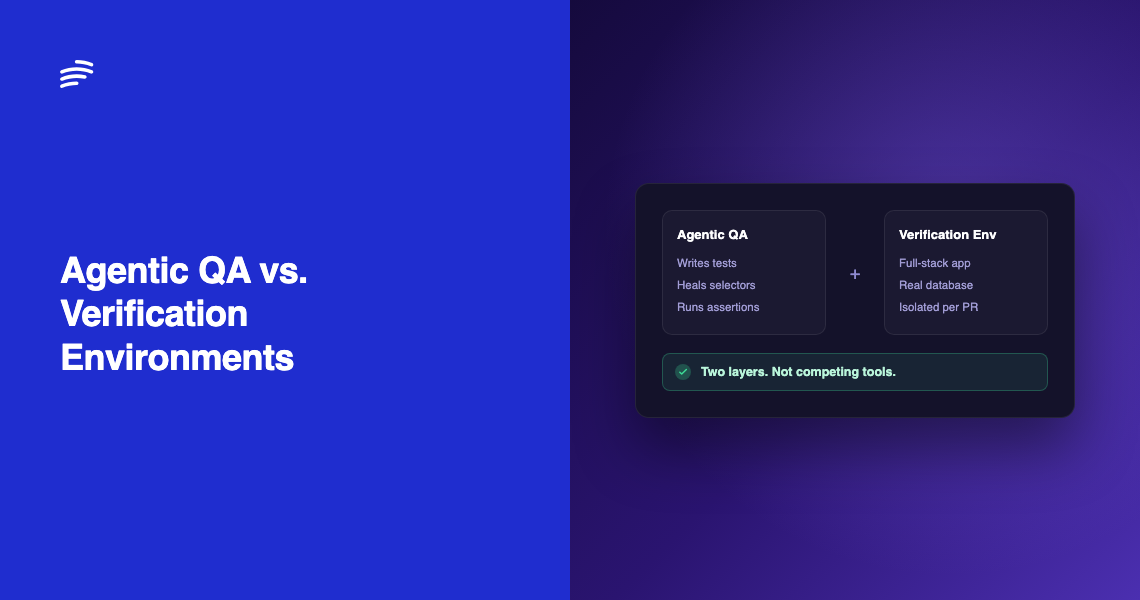
Do we need agentic QA tools and verification environments, or just one? Both, if you're testing AI-generated code seriously. Agentic QA (Playwright Agents, Mabl, Autify) writes and maintains the test scripts. Verification environments (Bunnyshell) provide the real, isolated, production-parity target those scripts run against. Neither replaces the other because they solve different problems.
Can agentic QA platforms provision their own test environments? No, not in the sense of standing up your actual application stack. They run in their own cloud infrastructure and execute tests against a URL you give them. That URL still has to point at something real — your staging server, or a dedicated environment — which is a separate problem from generating and maintaining the tests themselves.
Is it risky to build our testing strategy entirely around one agentic QA vendor? Yes, more than most teams price in. OctoMind, an AI-powered Playwright testing platform, shut down in May 2026 with no acquirer. Teams that had built their entire E2E strategy inside its cloud lost their test suites, not just a vendor relationship. Keeping the environment layer underneath your tests separate and portable is what makes a vendor swap an inconvenience instead of a rebuild.
Which should we adopt first, agentic QA or verification environments? Verification environments first, in most cases. A great test suite pointed at a stale or shared environment produces false confidence. A mediocre test suite pointed at a real, isolated environment still catches integration bugs mocks and unit tests miss. Get the target right, then invest in making the tests smarter.
Is agentic QA or a verification environment overkill for a small team? Both can be, below a certain volume. A small team merging a handful of PRs a week can outgrow neither layer's problem yet — a hand-written test suite and a single shared staging environment may genuinely be enough. The signal to invest in both is high PR volume causing staging contention plus test-maintenance burden becoming someone's de facto job.
How much does switching agentic QA vendors actually cost if the two layers are kept separate? Roughly a migration of test scripts and CI configuration — hours to days for most teams, not weeks — because the environments underneath, and the application they test, don't change. That cost only balloons if the same vendor also owned environment provisioning, which is the specific setup this piece argues against.
The layer underneath your test suite.
Full-stack, production-parity environments per pull request — portable, vendor-agnostic infrastructure your testing tools point at. Swap testing tools freely; the environments stay yours.