For Developers
Stop Filing Tickets.
Start Shipping Code.
Self-service environments for every PR. No DevOps queue. No broken staging.
14-day trial · No credit card required
 Helm
Helm Docker
 Terraform
 K8s
K8s EKS
EKS AKS
AKS GKE
GKE SOC 2
SOC 2 ISO 27001
 ISO 9001
Trusted by over 30,000 engineers from
“Manual tests on Argo CD PRs now take me seconds. When you review dozens of PRs a day, that's a game-changer.”


“Automatically created a Bunnyshell environment based on PRs, speeding up the entire task implementation process.”


“The automation and scalability that Bunnyshell provides complements the DigitalOcean platform, empowering developers to build amazing products.”


Sound Familiar?
Your day shouldn't look like this.
But it probably does.
"Who broke staging?"
You share one staging environment with 20 developers. Someone deployed a broken branch. Now everyone's blocked until someone figures out who did it and rolls it back.
3-day wait for an environment
You need a testing environment for your feature branch. You file a ticket. DevOps is backed up. Three days later, you're still waiting — and your PR is stale.
"Works on my machine"
Your local setup drifted from production months ago. Missing services, wrong database version, outdated config. You spend half of Monday just getting things running.
QA can't test your PR
Your code is ready for review but QA has no way to see it running. You screen-share on a call. Or worse — you merge to staging and hope for the best.
Context switching kills flow
You're deep in a feature when an urgent bug comes in. Switching branches means tearing down your setup and rebuilding from scratch. There goes your afternoon.
Docker Compose ≠ Production
Your local Docker Compose stack is a pale shadow of production. No load balancer, no real DNS, no database with production-like data. You find out in prod.

Done waiting for environments?
Deploy your first environment in under 30 minutes. 14-day trial, no credit card required.
Your Own Environment for Every PR
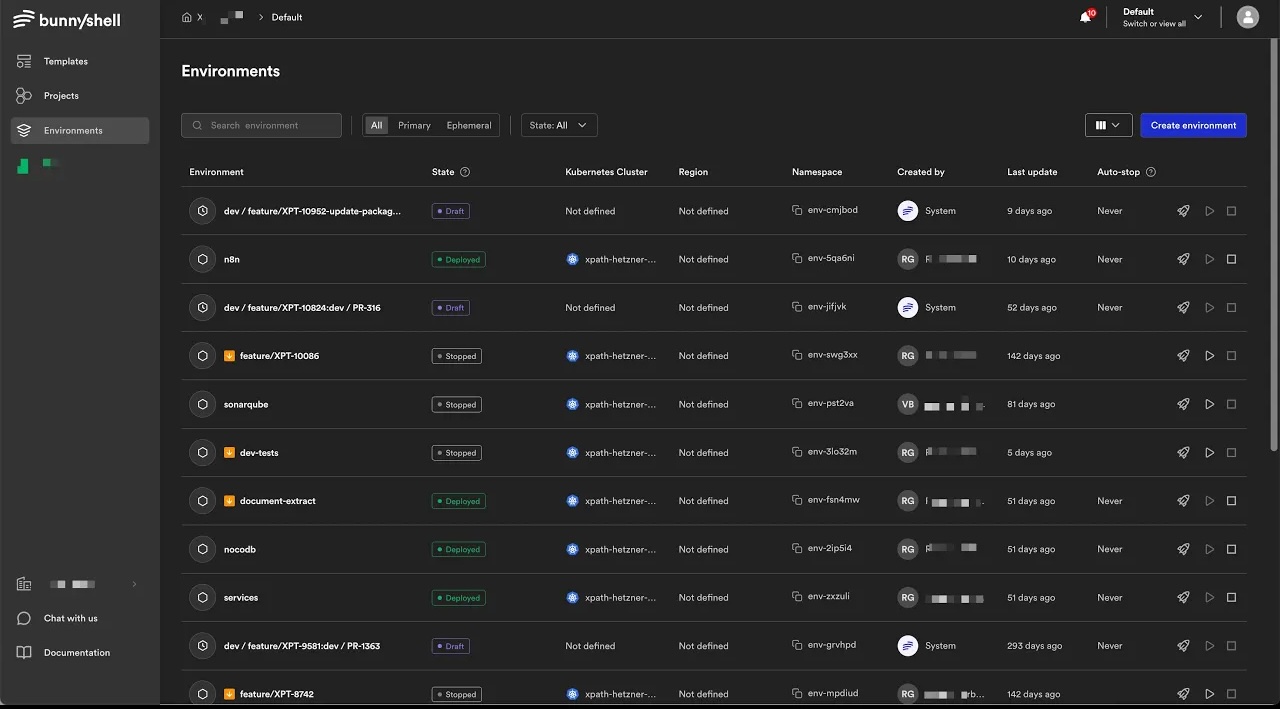
Open a pull request. Your full-stack environment deploys automatically — your app, your database, your infrastructure. Isolated, production-like, with a shareable URL. Merge the PR, the environment destroys itself. No cleanup, no forgotten resources.
- Auto-deploy on PR open — environment spins up in minutes with a preview URL you can share with QA, PM, or anyone
- Full-stack, not just frontend — app + database + infrastructure, not a static preview
- Auto-destroy on merge — no orphaned environments, no bill creep
- Git ChatOps — /bns:deploy, /bns:stop, /bns:start right from PR comments
Your IDE, a Cloud Runtime
Code in VS Code or JetBrains. Your changes sync instantly to a cloud environment that mirrors production. Real-time file sync, step-through debugging, zero local dependencies. Stop fighting your laptop — start coding in minutes.
- VS Code & JetBrains — your IDE, your keybindings, your extensions. The runtime is in the cloud
- Real-time file sync — save a file locally, see it reflected instantly in your cloud environment
- Remote debugging — step-through for Node.js, PHP, Java. Attach your debugger to cloud containers
- Port forwarding — access any remote service as if it were running on localhost
Preview URLs for Every Branch
Every environment gets a unique, shareable URL. Drop it in the PR, send it to QA, share it with your PM. No screen-sharing, no "let me deploy to staging first." Anyone with the link sees your code running — exactly as it would in production.
- Auto-posted to PRs — the preview URL appears as a PR comment automatically
- Per-component URLs — separate URLs for frontend, API, admin panel — whatever you need
- Custom domains — assign your own domain for demos, client reviews, or UAT
- IP whitelisting — restrict access for sensitive environments
CLI & API — Your Terminal, Your Way
Everything you can do in the UI, you can do from your terminal. Create, deploy, port-forward, SSH into containers, start remote dev sessions — all without leaving your workflow.
- Full CLI — create, clone, start, stop, deploy, port-forward. Shell autocomplete included
- REST API & Go SDK — automate anything. Provision environments, query status, trigger teardowns
- MCP Server — manage environments from Claude Code or any MCP-compatible AI agent
- SSH access — drop into any container. Inspect logs, run commands, troubleshoot in real-time
Works with the tools
already in your workflow.
Case Study

Developers who stopped
waiting for environments.
“Manual tests on Argo CD PRs now take me seconds. When you review dozens of PRs a day, that's a game-changer.”
“Automatically created BunnyShell environment based on PRs, speeding up the entire task implementation process.”

“I can do with Bunnyshell and a DevOps person what my clients are doing with 4 DevOps people.”

“From a release once in 2-4 weeks to multiple times per week, and nobody's stressed about it.”
Deploy your first environment in minutes.
14-day free trial, no credit card required. Your code, your cloud, your IDE — just faster.
Frequently asked
questions
Can’t find what you’re looking for? Talk to our team
No. If you have a Docker Compose file, Bunnyshell converts it to Kubernetes resources automatically — health checks, volumes, cron jobs, ingress, and HPA. You keep writing Docker Compose, we handle the orchestration.


