E2E Testing with AI Coding Agents: A Practical Guide
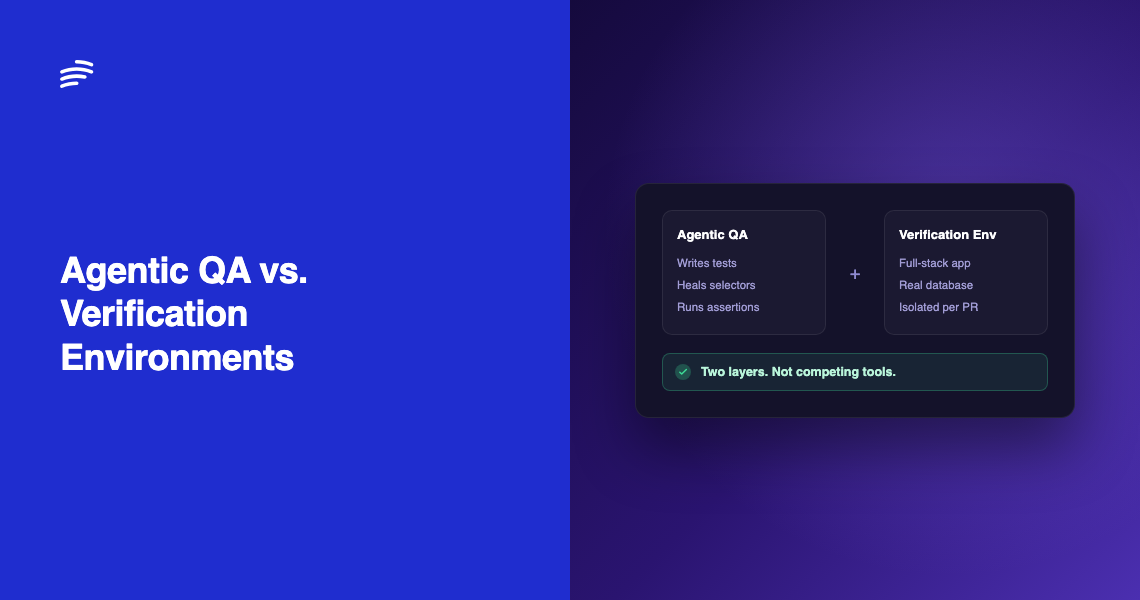
"E2E testing with AI agents" means two different things, and most content on this topic doesn't say which one it's talking about — a search for the phrase turns up tool roundups for one meaning and testing-strategy advice for the other, rarely both, and rarely with the distinction named.
Two different problems with the same name
AI agents that perform E2E testing. Playwright shipped three first-party agents in 2026: a Planner that explores your app and writes a test plan, a Generator that turns that plan into executable Playwright spec files, and a Healer that repairs tests when selectors break. Install them with npx playwright init-agents, provide a seed test, and you get ordinary Playwright files in your repo that run in your existing CI — no new runtime, no vendor lock-in. Agentic QA platforms like Mabl and Autify take a further step, generating and self-healing entire suites from natural language.
E2E testing of code written by AI agents. This is the other direction: verifying that a pull request Claude Code, Cursor, or Copilot just opened actually works when the full application runs together — not just that it compiles, passes lint, and satisfies a unit test the same agent wrote.
Both matter. But they solve different problems, and conflating them leads teams to think a self-healing test suite is a substitute for a real environment to run it against. It isn't. A Playwright Healer that's very good at keeping a spec file passing tells you nothing if the environment it's running against isn't a faithful copy of production.
This guide is about the second problem — how to actually verify AI-generated code end-to-end — with the first covered where it's genuinely useful: as a way to generate and maintain the tests you'll run against a real environment.
Why this needs more E2E testing, not less
The instinct with any productivity tool is that it should reduce downstream work. AI coding agents don't, and the data says so plainly. In the same 300-engineer survey:
| Metric | Result |
|---|---|
| Teams whose bug volume rose since AI-generated code started shipping | 52% (only 2% saw a decrease) |
| QA engineers whose testing workload grew as a result | 58% |
| Of those, teams that got additional QA headcount to cope | 0% |
| Respondents who changed their testing approach specifically for AI-generated code | 74.2% |
Source: DeviQA, State of AI-Generated Code 2026, 300 QA engineers, SDETs, and test leads surveyed.
And the bottleneck isn't just testing capacity — it's review capacity ahead of testing. LinearB's 2026 analysis of 8.1 million pull requests across 4,800 teams found AI-generated PRs sit for more than 16 hours before a reviewer picks them up, versus roughly 200 minutes for unassisted work — over 5x longer — and merge within 30 days at 32.7%, versus 84.5% for human-authored PRs. More code, more scrutiny needed per PR, the same number of humans to do it. Automated E2E verification isn't optional at that ratio; it's the only thing that scales with PR volume the way review capacity doesn't.
What actually breaks in E2E tests when the code is AI-generated
Unit tests — often written by the same agent that wrote the code — tend to validate that a function does what it was told to do. They rarely catch what breaks when that function meets the rest of the system. In practice, four patterns show up repeatedly:
Cross-service assumptions that were never true. An agent editing one service assumes a field, an error shape, or a response time from another service, based on what's in its context window. That assumption is often wrong in ways a mocked unit test can't see and only a real, running dependency exposes.
Auth and permission edge cases. Agents write for the happy path unless explicitly prompted otherwise. The expired-token retry, the role that shouldn't have access, the session that should have been invalidated — these are exactly the paths E2E tests exist to walk, and exactly the paths that don't show up in a function-level unit test.
Async and ordering bugs. Race conditions and ordering assumptions that don't fail in isolation fail under realistic concurrent load — which only a full environment under something resembling real traffic will surface.
Data shape drift between what was generated and what's actually stored. An agent working from a schema in its context can generate code against a slightly stale or incomplete picture of the real data model, especially in a codebase mid-migration.
None of these are exotic. They're the standard categories of bugs that E2E testing has always existed to catch — they're just showing up more often, because more code is shipping without a human's full mental model of the system behind it.
Each pattern has a reason it's specifically more common in AI-generated code, worth being explicit about:
Cross-service assumptions happen because an agent's context window is bounded — it sees the file it's editing and whatever's been pulled in as context, not the live behavior of every service it calls. A human engineer who's worked on the payments service for a year carries assumptions about its edge cases that never make it into any file an agent can read.
Auth and permission gaps happen because "make this work" prompts, explicit or implicit, optimize for the demonstrated case. An agent asked to add a feature will make it work for a logged-in user with normal permissions, because that's the scenario in the ticket. Nobody has to remember to ask for the expired-session case — but nobody automatically gets it either, human or AI, unless the test suite demands it.
Async and ordering bugs happen because reasoning about concurrent execution correctly is hard for any developer, and an agent's training data is dominated by code that's correct in the common case and silent about the specific ordering guarantees that make it correct. It reproduces the pattern without necessarily reproducing the reasoning that made the pattern safe in the original context.
Data shape drift happens because an agent's picture of "what the data looks like" comes from whatever schema, type definition, or example it was shown — which goes stale the moment a migration runs that the agent's context didn't include. A human on the team who ran the migration remembers it happened. An agent starting a fresh session has no such memory unless it's re-derived from the current state of the code.
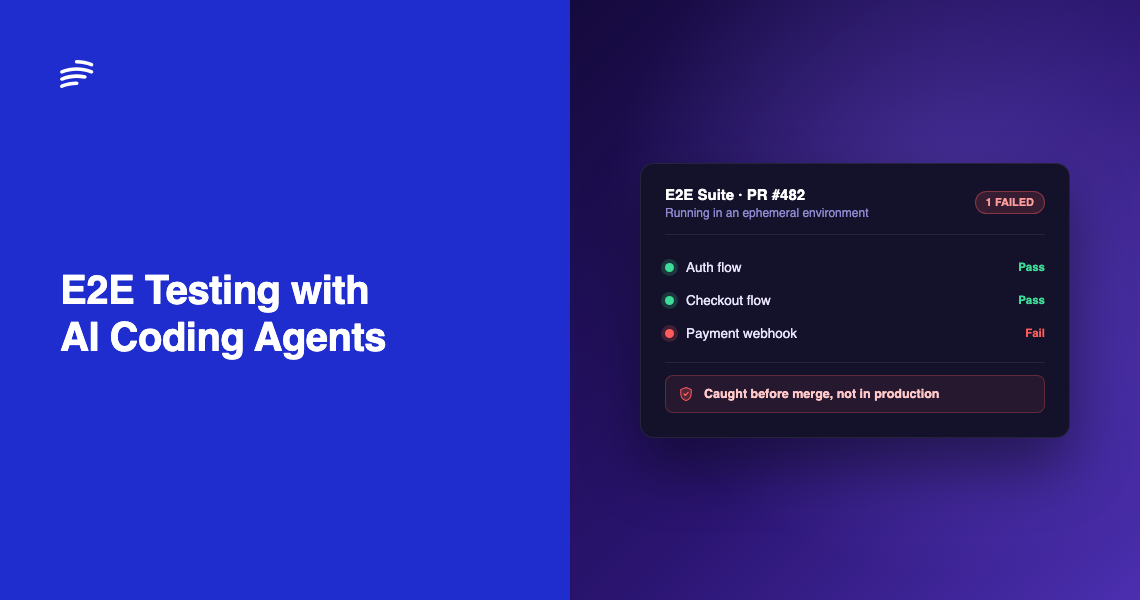
What this looks like in practice. An agent is asked to add a new payment method to checkout. It edits the checkout service, adds the new payment type, updates the request schema, and writes a unit test confirming the new type is accepted and processed. Everything passes. What it didn't touch — because nothing in its context window mentioned it — is the webhook handler that listens for payment confirmation events from the payment provider, which still assumes the old, smaller set of payment types and silently drops anything it doesn't recognize. Unit tests for the checkout service are green. The webhook handler's own unit tests are also green, because nobody changed its inputs. The failure only exists in the seam between the two services, under a real request that actually reaches both — which is precisely what an E2E test run against a full environment catches, and nothing else does.
What actually deserves E2E coverage
Not every code path needs an end-to-end test, and treating E2E as a blanket solution just trades one problem (bugs mocks miss) for another (a suite so large it's slow and nobody maintains it). The failure patterns above point to a practical filter: prioritize E2E coverage for anything that crosses a service boundary, touches auth or permissions, or depends on timing or ordering — the three categories AI-generated code diverges on most. A pure function with no external dependencies is exactly what unit tests are for, AI-generated or not; forcing it through a full-stack E2E run adds CI time without adding signal.
In practice this means the highest-value E2E coverage for AI-heavy codebases isn't "every user flow" — it's every point where two services actually talk to each other, every auth boundary a request crosses, and every workflow that involves a queue, webhook, or async callback. That's a smaller, more targeted suite than "test everything," and it's specifically aimed at the bugs unit tests structurally can't see.
The environment problem nobody mentions
Here's the part most "AI testing" content skips: an E2E suite is only as trustworthy as the environment it runs against. A test that passes against a stale staging environment, a subset of services, or mocked dependencies isn't telling you the PR works — it's telling you the PR works against something that isn't production.
That gets expensive fast once AI coding agents raise PR volume, because it collides with the same contention problem shared staging has always had: if every E2E run needs the shared environment, and AI agents are now opening PRs faster than humans did, either PRs queue for their turn on staging, or teams start accepting E2E results from an environment three other PRs have already touched. Neither is a real answer, and we've written about the practical migration path away from that model in detail.
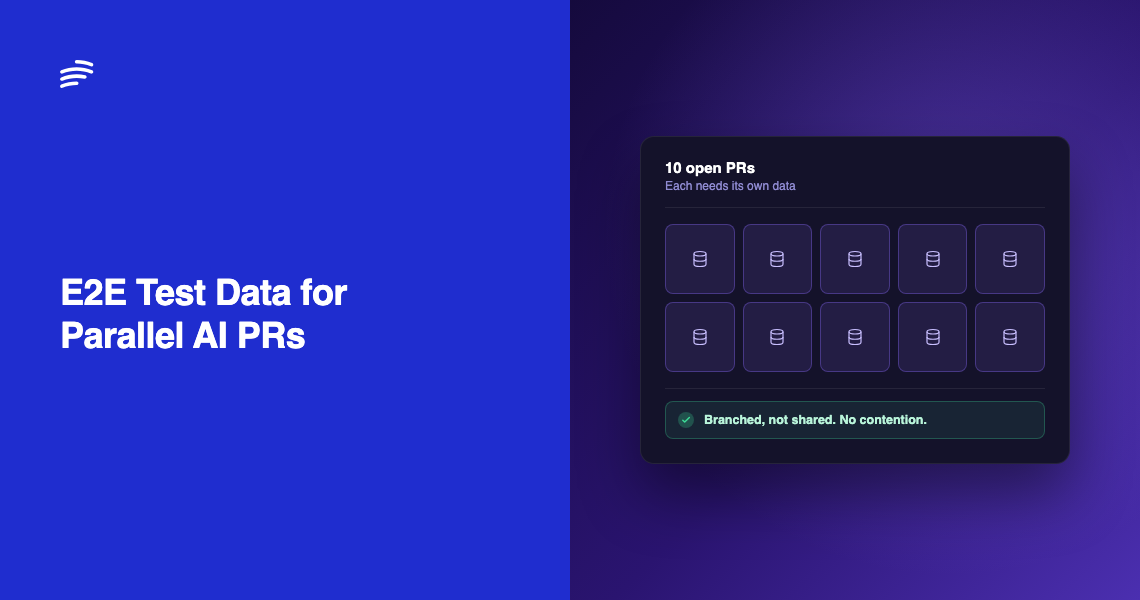
The requirement E2E testing actually has, once you say it plainly, is: every PR needs its own full, isolated, production-parity environment to run against, created automatically and torn down when it's no longer needed. That's not a testing-tool problem — it's an environment-provisioning problem, and it's the same one AI code governance runs into from the attribution and audit-trail side.
A practical pattern
Putting this together, the pattern that actually works looks like this:
- PR opens — by a human or an AI coding agent, doesn't matter.
- A full-stack, production-parity environment spins up automatically for that PR specifically — application, database, dependent services, real configuration.
- The E2E suite runs against that environment, not against staging and not against mocks. If you're using Playwright's Generator to maintain the suite itself, or the Healer to fix broken selectors, that happens here — it's a tooling layer on top of the environment, not a replacement for it.
- Results gate the merge. A failing E2E run against a real environment is a far stronger signal than a passing unit test suite against mocks.
- The environment is destroyed on merge, so the next PR gets a clean one instead of one that's accumulated drift from three previous branches.
This is exactly the pattern per-PR environments for microservices are built around — and it's why "which AI testing tool should we use" is the wrong first question. The first question is whether every PR gets a real environment to test against at all.
What this looks like in CI
Concretely, in a GitHub Actions workflow, the deploy step and the test step are two ordinary jobs — no custom orchestration required:
1- name: Deploy PR environment
2  uses: bunnyshell/deploy-action@v2
3  id: get-url
4  with:
5    bunnyshell-token: ${{ secrets.BUNNYSHELL_TOKEN }}
6    bunnyshell-organization: ${{ secrets.BUNNYSHELL_ORGANIZATION }}
7    environment-id: ${{ env.ENV_ID }}
8    wait: true
9    timeout: 600
10
11- name: Run Playwright tests
12  run: |
13    npx playwright install --with-deps chromium
14    PREVIEW_URL="${{ steps.get-url.outputs.preview_url }}" \
15      npx playwright test --reporter=github
The first step waits until the environment is actually healthy before handing back a URL; the second points the existing Playwright suite at that URL instead of localhost or a shared staging domain. Nothing about the test suite changes — the only thing that changes is what it's pointed at. The full workflow, including provisioning and teardown on merge, is in our GitHub Actions guide.
Metrics that tell you whether this is actually working
Once the pattern is running, four numbers tell you whether it's catching anything or just adding CI time:
- E2E pass rate, split by AI-authored vs. human-authored PRs. If they're identical, either your AI-generated code is unusually clean or your E2E suite isn't exercising the paths where AI code actually diverges (see the failure patterns above).
- Escaped defects — bugs that reached production despite a green E2E run. Rising escaped defects with a stable pass rate usually means the suite's coverage hasn't kept up with what the codebase does now.
- Mean time from PR open to first E2E result. This is your real velocity number. A slow environment-provisioning step defeats the point of automated verification just as surely as no verification at all.
- Environment cost per PR. Necessary once you're spinning up a full stack per pull request instead of one shared staging box — see the governance checklist for how to keep this attributable instead of a surprise line item.
None of these are vanity metrics. Each one answers a specific question a CTO or engineering lead will eventually ask, and having them ready before the question arrives is the difference between "here's the number" and "let us pull that together" — the second answer erodes confidence in the whole practice regardless of whether the underlying testing is actually working.
Common objections
"Isn't this what CI already does?" CI runs whatever you tell it to — usually unit tests, lint, and a build check. Most CI pipelines don't run a full E2E suite against a real, isolated environment by default, because until recently that meant fighting for time on a shared staging server. The CI mechanism isn't new; pointing it at a real per-PR environment instead of mocks or a shared box is the part that's missing.
"Won't this slow down merging?" Provisioning a full-stack environment adds minutes, not hours, when it's automated — and it replaces the much longer wait of queuing for shared staging or the much larger cost of a bug reaching production. The comparison isn't "E2E in an ephemeral environment vs. instant merge." It's "a few minutes now vs. an incident later."
"What about flaky E2E tests themselves?" A real, fair concern, and a big enough one to deserve its own answer rather than a paragraph here. The short version: a large share of E2E flakiness comes from shared, drifting environments and inconsistent test data — problems that isolated, freshly-built-per-PR environments remove structurally, rather than problems you patch with retries.
Who owns this
The pattern above spans three functions that don't always talk to each other: QA owns the test suite, platform or DevOps owns environment provisioning, and engineering owns the code being tested. When E2E-in-ephemeral-environments fails to get adopted, it's usually not a technical blocker — it's that nobody owns the seam between the three.
The working model that avoids this: QA owns what gets tested and the assertions themselves. Platform owns where it runs — the environment provisioning, TTL policy, and cost governance, treated as infrastructure with an SLA, not a favor QA requests. Engineering owns fixing what the suite finds, with the same urgency whether the PR was written by a human or an agent. None of the three needs to own the other's domain, but the CI wiring that connects them — deploy, then test, then gate — needs one clear owner, usually whoever owns the CI pipeline itself, so it doesn't become the thing all three assume someone else is maintaining.
FAQ
What is the difference between E2E testing with AI agents and AI agents that do E2E testing? They're two different problems that share a name. "AI agents that do E2E testing" means tools like Playwright's Planner, Generator, and Healer, or agentic QA platforms, that generate and run test scripts. "E2E testing of AI-generated code" means verifying that code written by Claude Code, Cursor, or Copilot actually works end-to-end before it merges. Most content on this topic conflates the two.
Can Playwright's AI agents replace end-to-end testing infrastructure? No — they replace the work of writing and maintaining test scripts, not the infrastructure those scripts run against. Playwright's Planner, Generator, and Healer still need a real, running, production-parity environment to test against. Without one, a self-healing test suite just gets very good at passing against the wrong environment.
Why do unit tests pass on AI-generated code that then fails in E2E? AI coding agents write code from the context of the file or function they're editing, not the full system. Unit tests, often written by the same agent, tend to validate what the function was told to do rather than what the rest of the system expects from it. Integration and cross-service assumptions only surface when the full stack actually runs together — which is what E2E testing checks and unit testing structurally cannot.
Do we need ephemeral environments specifically, or is a shared staging environment enough? Shared staging works until PR volume rises, and AI coding agents raise PR volume. E2E suites need a full, isolated, production-parity environment per run to produce a trustworthy result — shared staging means either queuing PRs for their turn or accepting cross-contaminated test results from concurrent deploys.
Does every PR need full E2E coverage? No. Prioritize E2E for anything crossing a service boundary, an auth boundary, or involving async timing — the categories AI-generated code diverges on most. Pure, dependency-free functions are better covered by unit tests regardless of who or what wrote them.
Who should own E2E-in-ephemeral-environments as a practice? Split by function: QA owns the test suite and assertions, platform or DevOps owns environment provisioning as infrastructure with an SLA, and engineering owns fixing what's found. The CI wiring connecting all three needs one explicit owner — usually whoever already owns the pipeline — so it isn't assumed to be someone else's job.
Give every PR a real environment to test against.
Full-stack, production-parity environments per pull request — automatic, isolated, destroyed on merge. Run your E2E suite against the real thing, not a shared staging server three PRs deep.