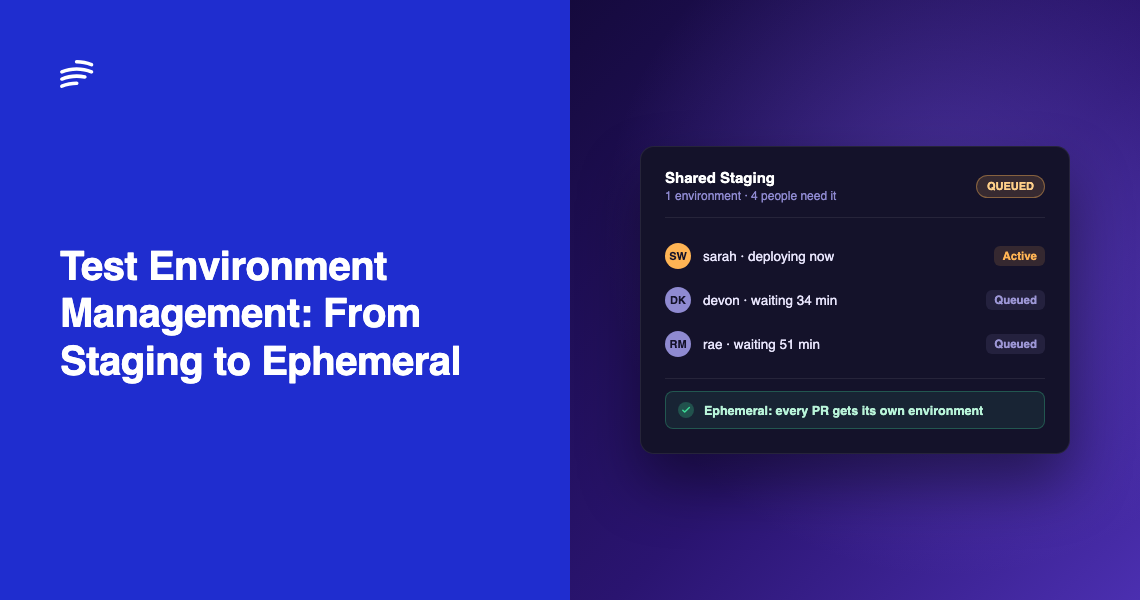
Test Environment Management: From Shared Staging to Ephemeral
Test environment management (TEM) sounds like a formal discipline, and industry frameworks like Enov8's TEMMi treat it as one — evaluating teams across eight capability areas, from environment knowledge management to data orchestration to status reporting. Most teams never touch that framework. They inherit a staging server from whoever set it up first, and management happens reactively, one incident at a time.
This isn't another "shared staging is bad" post — we've made that argument in detail already. This is about what comes after you agree it's bad: how to actually run test environment management as a practice, and how to migrate from shared staging to ephemeral without a six-month re-platforming project.
What test environment management actually means
If you want the 101 definition — what a test environment is, how it differs from dev and staging — we cover that separately. This is about the management layer on top of it: the answers to five questions you should be able to give at any moment, for any environment your team uses:
- Who owns it? Not who created it eighteen months ago — who's accountable for it today.
- What's deployed to it, and at what version? Environment drift is invisible until it causes a false pass or a false failure.
- How long does it live? Indefinitely-running environments are the default failure mode. Nobody decides to keep an environment forever; it just never gets a TTL.
- Who can create one, and under what constraints? Unrestricted environment creation is one of the fastest paths to both cost sprawl and "which one is the real one" confusion.
- What does it cost, and who's accountable for that cost? If the answer is "nobody looks at this," it's not managed — it's just running.
Most teams can't answer more than one or two of these for their staging environment. That's the actual gap "test environment management" is supposed to close.
Run the exercise honestly and the gaps show up fast. Ask a team who owns staging and you'll often get a person who left the company eighteen months ago, or "the backend team," which isn't an owner, it's a department. Ask what's deployed and the answer is frequently "whatever was last pushed," with no record of which branch or commit. Ask how long it's been running and the honest answer is usually "since we set it up" — no TTL was ever applied because nobody decided to apply one; it simply never came up. None of these are unusual failures. They're the default state of an environment nobody's managing, which is most environments most teams have.
What TEMMi's eight dimensions actually mean
The full TEMMi framework is more detailed than most teams need, but the eight capability areas it evaluates are worth translating into plain language once, because they're a more complete checklist than the five questions above:
| TEMMi dimension | In practice |
|---|---|
| Environment Knowledge Management | Is there a record of what each environment is, or does that knowledge live in one person's head? |
| Environment Demand Awareness | Do you know how many environments will be needed next sprint, or do you find out when someone can't get one? |
| Environment Planning & Coordination | Is allocation planned, or is it whoever asks first in Slack? |
| Environment Service Management | Are environment requests handled like a service with an SLA, or as favors? |
| Application Orchestration | Can you deploy a full application stack on demand, or does it require manual steps every time? |
| Data Orchestration | Is test data provisioned automatically and consistently, or copied by hand when someone remembers? |
| Infrastructure Orchestration | Is the underlying infrastructure (compute, network, storage) provisioned as code, or clicked together? |
| Status Accounting & Reporting | Can you report environment health, cost, and utilization on demand, or would someone need a week to compile it? |
You don't need a perfect score across all eight to be "managed" — most teams that feel like they've solved this are strong on four or five and consciously deferring the rest. What TEMMi is actually useful for is naming the gap precisely instead of the vague sense that "our environments are a mess": it's usually one or two specific dimensions, not all eight at once, and knowing which ones changes what you fix first.
The four stages most teams pass through
You don't need to memorize an eight-dimension framework to know where you stand. In practice, teams move through roughly four stages, and the failure mode at each one is different:
| Stage | What it looks like | What breaks |
|---|---|---|
| 0. Local only | Everyone tests on their own machine, maybe with Docker Compose | "Works on my machine." No shared source of truth before merge. |
| 1. One shared staging | A single static environment everyone deploys to | Contention, overwritten deploys, the environment is broken more than it works |
| 2. Scheduled or pooled staging | Booking calendars, a pool of 3-5 named environments, a Slack bot for claims | Coordination overhead replaces contention. You've added process, not capacity. |
| 3. Ephemeral, per-request | Every PR or task gets its own full-stack environment, auto-created and auto-destroyed | Cost and governance become the new problem if nobody's watching TTLs and spend |
Stage 2 is where most teams get stuck for years, because it feels like a solution — you've gone from chaos to a system with rules. It isn't one. You've built a queue for a scarce resource instead of removing the scarcity. The real cost of a shared staging environment doesn't disappear when you add a booking calendar; it just becomes visible in coordination overhead instead of outright breakage.
Stage 3 isn't automatically "solved" either — it trades contention for a different failure mode: environment sprawl, untracked spend, and no audit trail. That's a governance problem, not an infrastructure problem, and it's the one most "just switch to ephemeral" advice skips.
What stage 2 actually looks like, six months in. A team builds a Slack bot: /claim-staging-2, /release-staging-2. It works, for a while. Then the team doubles. Now there are two bots, three staging pools, and a spreadsheet someone built to track which pool maps to which feature branch because the bot only handles claims, not what's actually deployed where. QA has learned to ping the channel before trusting a "pass" from staging-3, because staging-3 has a known issue nobody's had time to fix since March. This isn't a hypothetical — it's the median outcome of stage 2 at the 15-30 engineer mark, and it's why stage 2 teams describe their process as "working" right up until someone tries to explain it to a new hire.
The management practices that actually matter
Whether you're at stage 1 or stage 3, the practices that separate managed from running are the same:
A single source of truth. One place — not three Slack channels and a wiki page from 2023 — that says what environments exist, who owns them, and what's deployed to each. If your team's honest answer to "how do we know what's running in staging" is "ask in the channel," you don't have this yet.
TTL as a default, not an exception. Every environment gets an expiration when it's created. Indefinite lifetime should require a deliberate decision, not be the default nobody chose.
Provisioning rules, not free-for-all creation. Decide who can spin up an environment and what it's allowed to cost, before sprawl makes that decision for you.
Lifecycle and cost tracking that isn't manual. If tracking what's running means someone periodically checking a cloud console, it will get skipped the week that person is busy — which is every other week.
KPIs that catch drift before it's an incident. Environment uptime, mean time to a working environment, and unplanned environment-caused test failures are the three numbers worth watching. If nobody owns those numbers, nobody notices when they get worse.
None of this requires ephemeral environments specifically. You can run a disciplined, well-governed shared staging setup. Almost nobody does, because discipline at stage 1 or 2 fights the architecture the whole time — you're manually enforcing constraints that ephemeral environments enforce structurally, by construction (an environment that auto-destroys in 4 hours doesn't need someone to remember to clean it up).
Where each practice actually lives, in tooling terms. A single source of truth is usually a catalog — either a dedicated environment-management tool or, at minimum, a tagged view inside whatever provisions your infrastructure (Terraform state, a Kubernetes namespace list, a platform-engineering portal). TTL enforcement lives at the provisioning layer, not in a wiki policy — if the platform doesn't expire environments automatically, "TTL as policy" quietly becomes "TTL as suggestion" within a quarter. Provisioning rules are RBAC, applied to whatever creates environments, same as any other production-adjacent system. Cost tracking is either a cloud cost tool with environment-level tagging or, more reliably, built into the provisioning platform itself so tagging can't be skipped. None of these require new headcount — they require the practice to be enforced by a system instead of remembered by a person, which is the same principle running through all five.
The migration playbook: shared staging to ephemeral
This is the part most "why ephemeral is better" content skips. A practical path, in order:
- Pick one service, not the whole system. The service with the most PR volume and the most staging contention is usually the best pilot — it's where the pain is worst and the win is most visible.
- Automate that service's environment build before you automate the trigger. If spinning up a working copy of the service still needs three manual steps, fix that first. Ephemeral just runs your existing build process more often and in parallel — it doesn't remove manual steps for you.
- Run pilot and shared staging in parallel for one full sprint. Don't cut over on day one. Let the team compare directly: same bugs caught, same or better speed, before staging gets decommissioned for that service.
- Decide your data strategy before you need it. Seed data, anonymized production snapshots, or synthetic fixtures — pick one per service and make it repeatable. This is the step most migrations underestimate and the one that causes the most rollback requests.
- Set TTL and cost limits from day one, not after the first surprise cloud bill. It's much easier to loosen a limit than to retrofit one onto environments people have gotten used to running indefinitely.
- Expand service by service, not all at once. Each service you convert should follow the same pattern: automate the build, pilot in parallel, cut over, decommission that service's slice of shared staging.
- Decommission shared staging last, not first. It's tempting to kill the thing everyone hates as soon as the first service works. Keep it running, scoped down, until every service that depended on it has a real replacement — otherwise you've just moved the contention to whatever's left behind.
What this looks like on a real timeline. Week one: pick the checkout service — highest PR volume, worst staging contention, most visible pain if it works. Automate its build if it isn't already (most teams discover step 2 takes longer than expected here, because "automated" often means "one engineer knows the manual steps by heart," which isn't automation). Week two: first pilot PRs get ephemeral environments alongside the existing staging deploy, same test suite run against both, results compared. By the end of week two you either have a clean win (same or better bug-catch rate, faster feedback) or a specific, nameable gap — usually a data dependency the pilot didn't account for. Weeks three through six: expand service by service, each one repeating the same two-week pattern, usually compressing as the team gets faster at the automation step. Shared staging gets fully decommissioned somewhere around week eight to twelve, not week one — the teams that try to kill it in week one are the ones who end up rebuilding a "temporary" shared environment for the two services that weren't ready yet.
Shared staging vs. ephemeral, side by side
| Dimension | Shared staging | Ephemeral, per-request |
|---|---|---|
| Environment count | 1-5 static environments | One per active PR or task, created on demand |
| Conflict rate | High — every concurrent deploy is a collision risk | None — each environment is isolated |
| Setup time for a new test | Minutes to hours, if one is free | Minutes, always available |
| Cost model | Fixed, always-on, easy to under-track | Usage-based, requires active TTL and spend governance |
| Drift risk | High — long-lived, accumulates undocumented changes | Low — rebuilt from source every time |
| Ownership model | Diffuse ("everyone" = no one) | Scoped to the PR or task that created it |
The honest trade-off: shared staging is simpler to reason about on day one and gets worse every month afterward. Ephemeral is more work to set up correctly and gets easier every month afterward, provided the governance piece — TTL, cost limits, audit trail — is built in from the start rather than bolted on later. That asymmetry is why the migration decision is time-sensitive in a way most infrastructure decisions aren't: the longer a team waits, the more expensive the day-one setup cost becomes relative to the ongoing cost of staying on shared staging, because team size and PR volume — the two variables that make shared staging worse — only move in one direction. See our CTO's guide to AI code governance for how that governance layer extends to AI-generated PRs specifically, where the volume problem is even more acute.
Common objections
"Isn't this what our platform team already handles?" Sometimes, but check against the five questions above rather than assuming. A platform team that provisions infrastructure isn't automatically managing test environment lifecycle, ownership, and cost — those are frequently a gap even in orgs with a strong platform function, because "provision environments" and "manage environments as a system" are different scopes of work.
"We tried a booking calendar and it works fine." It works fine at current team size. The question worth asking isn't whether it works today — it's what happens when PR volume doubles, which for teams adopting AI coding tools is a matter of months, not years. Booking systems degrade non-linearly: fine at 10 people, friction at 20, a full-time coordination job at 40.
"We don't have the DevOps resources to build this." The migration playbook above doesn't require a platform team or months of infrastructure work — it requires automating one service's build, which is usually a few days of work by whoever already deploys it manually. The resourcing question is more often "who has a few days" than "do we have a platform team," and managed platforms exist specifically to remove the infrastructure-building step entirely.
"Ephemeral sounds like it'll just cost more — more environments running." Ephemeral environments running for the lifetime of a PR and destroyed on merge typically cost less than a handful of static environments running 24/7 regardless of use, once TTL and auto-stop are actually enforced. The cost risk is real, but it's a governance risk (sprawl without limits), not an inherent property of the architecture.
Where this fits in your stack
Bunnyshell's role is the automation and governance layer for stage 3: every pull request gets a full-stack, production-parity environment automatically, with TTL and auto-stop built in rather than left to someone's memory, spend tracked and capped per environment, and RBAC plus a full audit trail — who deployed what, when, from which environment — so "who broke staging" stops being a question anyone has to ask. See how per-PR environments work for microservices for the technical pattern, or what this looks like for engineering leaders for the governance and reporting side.
FAQ
What is test environment management? Test environment management (TEM) is the discipline of tracking, provisioning, and governing the non-production environments a team uses to test software — who owns each one, what's deployed to it, how long it lives, and how conflicts get resolved. Most teams don't have TEM as a practice; they have a shared staging server and a Slack channel.
Do we need a formal maturity model, or can we just start fixing things? You can start fixing things without adopting a named framework. The maturity stages are useful for diagnosis — to see which stage you're actually in versus which one you think you're in — not as a checklist you must complete in order.
Is booking or scheduling staging a reasonable fix? It's a reasonable stage-2 fix, not an end state. Scheduling adds fairness to a scarce resource, but the resource is still scarce. It caps how many people can test in parallel and adds coordination overhead that ephemeral, per-request environments remove entirely.
How long does migrating from shared staging to ephemeral actually take? For a single service with a reasonably automatable deploy, teams typically get a working per-PR environment pattern running in one to two weeks, including the pilot period. Full migration across a multi-service system depends on how many services still require manual environment setup steps — those get converted incrementally, not all at once.
Do we need a platform team to do this? No. The migration playbook starts with automating one service's build, which is usually days of work for whoever already deploys that service, not a platform initiative. A dedicated platform function makes later stages smoother, but it isn't a prerequisite for starting.
Will ephemeral environments cost more than our current staging setup? Usually less, once TTL and auto-stop are actually enforced — ephemeral environments run only for the life of a PR, while static staging environments typically run 24/7 regardless of use. The cost risk with ephemeral is sprawl without governance, not the architecture itself.
Skip the queue. Give every PR its own environment.
Full-stack, production-parity environments per pull request — automatic TTL, cost caps, and a full audit trail. See what stage 3 actually looks like.