E2E Test Data Management for Parallel AI-Generated PRs
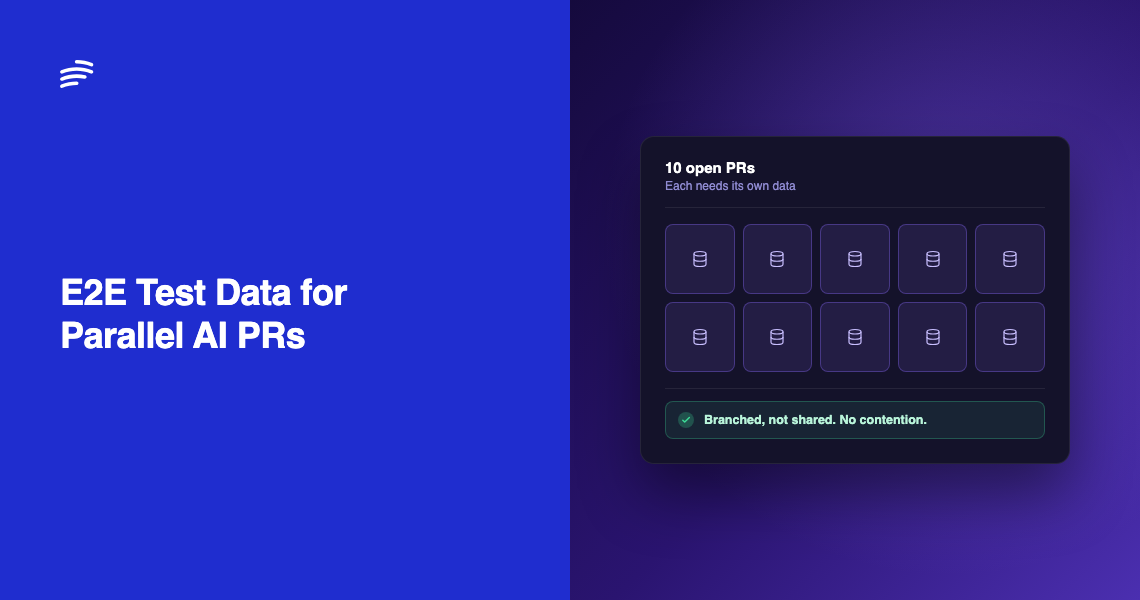
If ten pull requests are open at once — a normal number once AI coding agents are generating a meaningful share of PRs — and each gets its own full-stack environment, each of those ten environments needs a database with working, realistic data in it. Point all ten at the same database and you've rebuilt shared staging with extra steps: one PR's test run inserts a row another PR's test wasn't expecting, and now failures are non-deterministic again.
This is the same failure mode covered in our piece on flaky E2E tests under "order dependency" — except here the shared state isn't a leftover test artifact, it's the entire database. Fixing environment isolation while leaving data shared doesn't remove the contention; it just moves it one layer down, from "who's deploying to staging right now" to "whose test data is another test's test data right now."
Three strategies, and what each actually costs you
| Strategy | Speed to provision | Coverage | Where it breaks down |
|---|---|---|---|
| Static seed fixtures | Fastest — just load a known file | Only what someone thought to write | Schema drift; fixtures silently go stale as the real model changes |
| Synthetic generation | Moderate — generation runs per environment | Can cover edge cases fixtures miss, if the generator is good | Generators that don't model real relationships produce data that's realistic-looking but structurally wrong |
| Anonymized production snapshot | Slowest, unless the database supports branching | Highest — real relationships, real edge cases, real messiness | Anonymization has to be airtight and automatic, not a manual step someone might skip |
None of these three is universally correct, and picking the wrong one for a given service tends to show up as recurring, hard-to-diagnose test failures long before anyone traces it back to the data strategy. The right choice depends on how complex your data relationships actually are and how much that complexity matters to what you're actually testing.
Static seed fixtures, in practice, are a SQL dump or a set of JSON/YAML files checked into the repo and loaded on environment startup — a handful of users, a handful of orders, enough to exercise the main flows. They're the right default for any service where the data model isn't the point of the test: an auth service, a notifications service, anything where "a user exists and has a known ID" is sufficient setup. Where they break down specifically: any test that depends on data volume (pagination, performance under load) or on relationships the fixture author didn't think to represent.
Synthetic generation means a script or library (Faker-style generators are the common building block) produces plausible data at environment provisioning time, rather than loading a fixed file. Done well, this can generate realistic volume and edge cases — long names, unicode, boundary dates — that a hand-written fixture never covers, because nobody sits down and writes a thousand-row fixture by hand. Done poorly, it generates a thousand rows that are individually plausible but collectively wrong: an order referencing a product ID that doesn't exist in the generated product table, because the generator didn't model the foreign key relationship, only the individual field shapes.
Anonymized production snapshots mean taking real production data — real relationships, real messiness, real edge cases nobody would think to write by hand — and stripping anything identifying before it reaches a test environment. This is the highest-fidelity option specifically because production data has already encountered every edge case your system produces in practice, by definition. The cost is the anonymization work itself, which has to be both thorough (nothing identifying survives) and structure-preserving (foreign keys still point at valid rows, formats still pass validation) at the same time — the harder of the three strategies to get fully right, and the most expensive to get wrong.
Why AI-generated PR volume changes the calculus
With a handful of PRs a day, almost any of the three strategies works — the cost of getting it slightly wrong is small because there isn't much concurrent demand. That math changes once PR volume rises. LinearB's 2026 analysis of 8.1 million PRs found AI-adopting teams merging significantly more pull requests than teams that aren't — which means more concurrent environments, which means whatever data strategy you picked now has to work correctly at ten or twenty times the concurrency it was designed for.
Static fixtures scale well here almost by accident: loading the same known file into ten environments is exactly as fast as loading it into one, run in parallel. Full production-snapshot copies scale badly by default — ten full database copies is ten times the storage and ten times the copy time, unless the underlying database supports something better.
Put concrete numbers on it: a team running five PRs a day against full-copy snapshots of a 20GB production database is already managing 100GB of daily copy traffic and the provisioning-time cost that comes with moving it. The same team at twenty PRs a day — a realistic jump once AI coding agents are opening a meaningful share of PRs — is looking at 400GB, and the provisioning step that used to take two minutes now queues behind infrastructure that wasn't sized for this. Nothing about the application changed; the data strategy's cost curve just stopped being flat exactly when the team could least afford a bottleneck reappearing.
Refreshing the reference dataset
Whichever strategy you land on, the underlying reference data — the fixture file, the generator's model, the production snapshot used as a branch source — goes stale eventually, and "eventually" arrives faster than most teams expect. A fixture written against last year's schema silently stops representing a field that's now required, and the first sign is usually a test failure that looks like a code bug until someone traces it back to the fixture itself. A synthetic generator built against last year's business rules produces orders that would be invalid under this year's validation logic. A production snapshot taken once and branched from for six months increasingly diverges from what production actually looks like now.
The practical fix is treating the reference dataset itself as something with an owner and a refresh cadence, not a one-time setup task. Fixtures and generators need to be updated in the same PR that changes the schema they represent — a schema migration that doesn't touch the fixture file is a signal something's about to break quietly, not a sign the fixture didn't need updating. Snapshot-based branch sources need a scheduled re-sync — weekly or monthly, depending on how fast the schema and business rules actually change — run through the same anonymization pipeline every time, not a manual one-off repeated occasionally when someone remembers. Automating the re-sync as its own scheduled job, separate from and independent of any individual PR's environment provisioning, keeps the reference dataset's freshness from depending on whether anyone happened to need a new branch recently.
Database branching changes the trade-off
Branchable databases — Neon and PlanetScale are the common examples — offer a fourth option that isn't really a fourth strategy so much as a fix for the anonymized-snapshot approach's biggest weakness. A branch is a copy-on-write clone: creating one takes seconds, not the time it takes to copy however many gigabytes your production database holds, because nothing is actually duplicated until a write diverges from the source.
We've documented this pattern directly with Neon Postgres, including the anonymization step that has to happen before a snapshot becomes a branch source — anonymize once, upstream, and every branch created from it inherits clean data automatically instead of needing its own pass. For the database-specific configuration — how components, replicas, and multiple app services sharing one database actually get wired into an environment definition — see the dedicated guides for PostgreSQL, MySQL, and MongoDB.
The mechanism, at a level worth understanding even if you never touch it directly: copy-on-write means a branch initially shares every data page with its source, and only starts consuming its own storage when a write diverges from that shared state. Ten branches created from the same anonymized reference dataset, before any test writes to them, cost close to the storage of one copy — not ten. That's what makes branching a genuinely different cost curve from full copies rather than just a faster version of the same thing: the cost scales with how much each environment's tests actually change, not with how many environments exist.
The practical difference between the two common branchable-Postgres providers: Neon branches at the storage layer and exposes branch creation through its API and CLI, aimed at fitting into an existing provisioning pipeline programmatically. PlanetScale (MySQL-compatible) built its branching workflow around a schema-change review process first, with data branching as part of that same model. Neither is strictly better — the choice tends to follow which database engine the application already uses more than a branching-feature comparison, and teams running both Postgres and MySQL services in the same system will likely end up managing both branching models rather than standardizing on one.
Compliance changes the calculus, not just the risk
Anonymized production snapshots carry a compliance dimension that fixtures and synthetic data don't, and it's worth being explicit rather than treating "anonymize it" as sufficient on its own. GDPR, CCPA, and similar regulations generally treat properly anonymized data as outside their scope — but "anonymized" has a real technical bar (irreversible, not just pseudonymized) that a quick find-and-replace script on names and emails usually doesn't clear. Pseudonymization — replacing an email with a consistent token so the same user maps to the same token everywhere — preserves referential integrity but is often still considered personal data under stricter regimes, because it's reversible with the right key.
This isn't a reason to avoid production-derived test data. It's a reason the anonymization pipeline itself needs a real specification, reviewed by whoever owns compliance, not just an engineering decision made once and never revisited. Given that 97% of organizations with an AI-related security incident lacked proper AI access controls and 63% had no AI governance policy at all, a test-data pipeline that quietly leaks real PII into environments spun up and destroyed dozens of times a day is exactly the kind of gap that specific data describes — invisible until an audit or an incident finds it.
Worth naming as a separate risk from the anonymization technique itself: ephemeral environments multiply the number of places real data could theoretically leak, even as they reduce how long any single copy exists. A dozen environments a day, each holding a full copy of anonymized (or worse, insufficiently anonymized) production data for a few hours, is a wider surface than one long-lived staging database — smaller blast radius per environment, more environments overall. The audit trail matters here as much as the anonymization itself: knowing which environments held which data snapshot, and confirming each was actually destroyed on schedule, closes the loop that anonymization alone doesn't.
Anonymization is a pipeline step, not a policy
The failure mode worth naming directly: a team decides production snapshots are the right call, writes an anonymization script, and runs it once, manually, the first time. Six months later nobody remembers whether the last three schema changes are covered by that script, and a field that shouldn't be there — a real email, a real name — is quietly present in a dozen ephemeral environments that get created and destroyed daily. The same governance discipline that applies to AI-generated code — provisioning rules, not a free-for-all, and a system instead of a person remembering — applies here. Anonymization belongs in the provisioning pipeline itself, run automatically every time a snapshot is taken, not as a manual step in a runbook.
Where seeding fits in the provisioning pipeline
Concretely, data provisioning is a step between environment creation and the environment being marked ready for tests — not something that happens inside the application, and not something a test itself should be responsible for triggering:
1- name: Deploy PR environment
2  uses: bunnyshell/deploy-action@v2
3  id: get-url
4  with:
5    bunnyshell-token: ${{ secrets.BUNNYSHELL_TOKEN }}
6    bunnyshell-organization: ${{ secrets.BUNNYSHELL_ORGANIZATION }}
7    environment-id: ${{ env.ENV_ID }}
8    wait: true
9
10- name: Seed test data
11  run: ./scripts/seed-test-data.sh
12  env:
13    DATABASE_URL: ${{ steps.get-url.outputs.database_url }}
14
15- name: Run E2E suite
16  run: npx playwright test
17  env:
18    PREVIEW_URL: ${{ steps.get-url.outputs.preview_url }}
The seeding step runs once, after the environment reports healthy and before tests start, using whichever of the three strategies fits the service — a fixture load, a generation script, or (for branchable databases) simply the branch creation itself, since the branch already contains fully-seeded data by construction and this step becomes close to a no-op. Keeping this as an explicit, visible pipeline step — rather than logic buried in the application's startup code or in a test's beforeAll hook — is what makes the strategy auditable and swappable later without touching the tests themselves.
A practical decision rule
- Schema is small and stable, relationships are simple: static seed fixtures. Fastest, and good enough.
- Schema is complex, but you don't have (or want) production data flowing into test environments: synthetic generation, invested in properly rather than as an afterthought — a generator that doesn't model foreign key relationships correctly is worse than fixtures.
- Schema is complex, relationships and edge cases matter, and you have a branchable database: anonymized snapshot via branching. This is the highest-fidelity option at the lowest ongoing cost, provided anonymization is automated.
- Schema is complex, relationships matter, and your database doesn't support branching: anonymized snapshot via full copy, accepting the storage and provisioning-time cost, or plan a migration to a branchable database before this becomes the bottleneck.
A worked example: one system, three strategies
Most real systems aren't one service with one data strategy — they're several services, each with a different answer once you apply the decision rule honestly. Take a typical e-commerce backend:
The auth service has a simple, stable schema — users, sessions, roles. Static seed fixtures cover this completely: a handful of known test accounts with different roles, loaded in milliseconds, never needing to change unless the auth schema itself changes.
The product catalog service has a moderately complex schema (products, categories, variants, pricing rules) but no sensitive data and no reason to touch production. Synthetic generation, invested in properly, produces thousands of realistic products with correct category relationships — enough volume to test pagination, search, and filtering in ways a ten-row fixture never could.
The order and payment service is where the real complexity lives — orders reference users, products, payment methods, and shipping addresses, all with edge cases (partial refunds, failed payments, split shipments) that took years of real usage to accumulate and that nobody would think to fabricate by hand. This is the service where an anonymized production snapshot via branching earns its cost: the edge cases are already there, for free, and branching keeps ten parallel PR environments from paying for ten full copies of that history.
Three services, three strategies, applied by the same decision rule to each — not a single company-wide policy that's wrong for at least two of the three. The mistake worth avoiding explicitly is treating "our data strategy" as a single decision made once at the company level; it's a decision made once per service, revisited as each service's schema and sensitivity actually change.
FAQ
Why does test data become a problem when moving to ephemeral, per-PR environments? Because every environment needs its own copy of working data, and the number of environments running at once scales with PR volume, not with team size. A team that opens 30 PRs a day because AI coding agents are writing much of the code needs 30 concurrent, independent copies of test data — or a shared source that reintroduces the contention ephemeral environments were meant to remove.
Should we use production data for E2E test environments? Only anonymized, and only when the schema is complex enough that synthetic data can't reasonably replicate real relationships and edge cases. Anonymization has to happen before the data reaches an ephemeral environment, not as a step someone remembers to run — build it into the provisioning pipeline itself.
What is the fastest test data strategy for ephemeral environments? Static seed fixtures, by a wide margin, because there's no generation or extraction step at provisioning time — the data is just loaded. The trade-off is coverage: fixtures only exercise the scenarios someone thought to write, while synthetic generation or anonymized snapshots can surface edge cases fixtures miss.
Can database branching solve the parallel test data problem? For teams on a branchable database like Neon or PlanetScale, yes, largely. Branching gives each environment a copy-on-write clone of a reference dataset in seconds without duplicating storage, which sidesteps both the speed problem of full copies and the contention problem of a shared database.
Is anonymized data still subject to compliance regulations like GDPR? Properly anonymized data (irreversible, not just token-substituted) generally falls outside GDPR's scope. Pseudonymized data — where the same value consistently maps to the same replacement, preserving referential integrity — is often still considered personal data under stricter interpretations, because it's technically reversible with the right key. The distinction matters enough that the anonymization spec should be reviewed by whoever owns compliance, not decided by engineering alone.
Where should data seeding happen in the deployment pipeline? As an explicit step between environment creation and marking the environment ready for tests — after the environment reports healthy, before the test suite runs. Keeping it a visible pipeline step, rather than logic inside application startup or a test's setup hook, keeps the strategy swappable later without touching the tests themselves.
Give every environment its own data, automatically.
Database components, branching integrations, and automated anonymization wired into environment provisioning — so parallel PRs never share a database by accident.