AI Writes Code in Minutes, Your Team Waits Days for Staging — The New Bottleneck Nobody's Talking About
AI coding assistants made writing code nearly instant. They did nothing for validating it. Across 2026's engineering benchmark reports, the same pattern shows up again and again: code generation sped up dramatically, and code review slowed down even more dramatically — turning validation, not writing, into the real constraint on how fast teams ship.
The Bottleneck Moved, It Didn't Disappear
For twenty years, "we need to ship faster" mostly meant "we need to write code faster." Compilers got faster. IDEs got smarter. Frameworks got more productive. Each generation of tooling attacked the same constraint: the time it took a human to produce working code. AI coding assistants solved that problem more completely than almost anyone expected — and in doing so, they didn't eliminate the bottleneck in software delivery. They just moved it somewhere nobody had scaled up to handle.
According to Sonar's 2026 State of Code Developer Survey (based on more than 1,100 professional developers), 42% of committed code is now AI-generated or AI-assisted. GitHub's May 2026 report puts a number on the review side of that equation: Copilot's code review feature alone processed over 60 million reviews, and more than 1 in 5 code reviews now involve an agent somewhere in the loop.
Writing code got fast. Nobody fixed what happens next.
38% of developers in the same Sonar survey say reviewing AI-generated code actually takes more effort than reviewing human-written code — not less. That's the opposite of what most teams assumed AI would do to their workflow, and it's the root of a bottleneck almost nobody budgeted for when they rolled out Copilot, Cursor, or Claude Code across their engineering org.
A Brief History of Where the Bottleneck Lives
Software delivery bottlenecks have a habit of moving rather than disappearing. It's worth naming the pattern explicitly, because it tells you where to look next:
- Pre-2010s: compiling and building. The constraint was how long it took to produce a binary. Incremental compilation and better build caching mostly solved this.
- 2010s: testing. Once builds were fast, the constraint became running enough tests to trust a release. CI parallelization and better test architecture (unit-heavy pyramids) mostly solved this.
- Early 2020s: deployment. Once tests were fast, the constraint became getting a validated build into a real environment. Containerization, Kubernetes, and CI/CD pipelines mostly solved this.
- 2026: validation and review. Now that writing, building, testing infrastructure, and deployment are all fast, the constraint has moved to the step that was always manual and always assumed to scale linearly with headcount: a human (or a system standing in for one) deciding whether a change is safe to ship, and an environment to check that decision against.
Each time, the fix wasn't "slow down the fast part." It was "scale up the part that didn't keep pace." That's the same shape of problem here — except this time the fast part (code generation) accelerated so quickly that the gap opened almost overnight, across nearly every engineering org running AI tools at scale.
What the 2026 Data Actually Shows
Every major engineering analytics vendor published a version of the same finding this year, from different data sets, all pointing the same direction:
| Source | Sample | Finding |
|---|---|---|
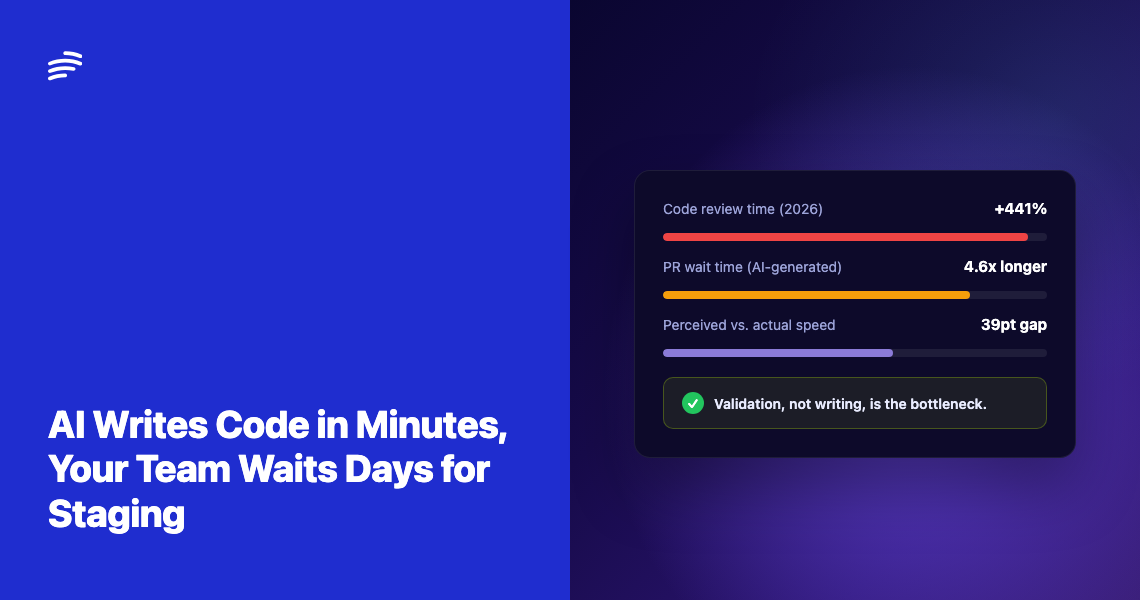
| LinearB (2026) | 8.1M pull requests, 4,800+ orgs | Developers feel 20% faster but are actually 19% slower — a 39-point gap between perceived and real productivity |
| Faros AI (2026) | 22,000 developers, telemetry-based | Median code review time up 441.5%, even as task throughput rose 33.7% |
| Opsera (2026) | 250,000+ developers, 60+ enterprise orgs | AI-generated pull requests wait 4.6x longer in review, even as time-to-open-PR dropped up to 58% |
| CircleCI (2026) | Platform-wide CI telemetry | Feature branch throughput up 59% year over year — but main branch throughput for the median team fell |
| DORA (2025 State of AI-Assisted Software Development) | ~5,000 technology professionals | Positive relationship between AI adoption and delivery throughput; negative relationship between AI adoption and delivery stability |
Read individually, each of these looks like a data point about code review specifically. Read together, they describe a single mechanism: AI adoption increases how much gets written and how fast it moves into a pull request. It does not increase how fast a human — or your infrastructure — can validate it's safe to ship. The gap between those two curves is the new bottleneck, and it shows up identically whether you're looking at review time, PR wait time, or the delta between feature-branch and main-branch throughput.
The most uncomfortable number in this data set isn't the review-time increase — it's LinearB's 39-point perception gap. Teams don't just have a slower pipeline; they believe they're shipping faster while the data says otherwise. That gap is exactly where budget and headcount decisions go wrong.
The Productivity Paradox, Explained
The LinearB finding deserves more than a table row, because "developers feel 20% faster but are actually 19% slower" sounds contradictory until you separate two different clocks that used to move together.
Clock one: time to write code. This is the clock developers experience directly, minute to minute. AI assistants make this clock feel — and actually be — dramatically faster. A feature that took a day now takes an hour. That feeling is real and it's not wrong.
Clock two: time from first commit to safely-in-production. This is the clock the business actually cares about, and it includes everything that happens after the code is written: review, CI validation, staging verification, QA sign-off, deployment, and any rollback or hotfix cycles triggered by problems found late.
Before AI tooling, these two clocks moved at roughly proportional speeds — writing code was a big enough share of total cycle time that making it faster meaningfully sped up the whole pipeline. AI broke that proportionality. Clock one sped up by multiples. Clock two didn't move, or moved backward, because review and validation capacity stayed flat while the volume arriving at that stage went up. Developers accurately perceive clock one getting faster. They just don't see clock two getting slower until someone measures deploy-to-production lead time directly — which is exactly why the perception gap persists inside individual teams even as the aggregate data across thousands of orgs shows the opposite.
This is also why "developers report feeling more productive" is a genuinely useless metric for AI tooling ROI on its own. It measures clock one. The business result depends on clock two.
Why Review — Not Code Generation — Is the Real Constraint
It's tempting to read "review time up 441%" and assume the fix is "get better at reviewing AI code" or "add more reviewers." The deeper research says the problem isn't reviewer skill or headcount — it's that the same amount of review capacity is now facing a much larger volume of changes, and worse, changes that are structurally harder to validate.
GitHub's own analysis of roughly 33,000 agent-authored pull requests found that non-merged agent PRs touched more files, involved larger changes, and failed CI validation more frequently than the ones that eventually merged. In other words: a meaningful share of AI-generated PRs are bigger, riskier changes than what a human would have opened — exactly the kind of change that needs more validation, not less, arriving at a rate the validation pipeline was never sized for.
A separate July 2026 study covering 1.02 million reviewed pull requests across 207 GitHub projects found something equally important: agent involvement was associated with faster review decisions — but those efficiency gains did not translate into better review quality. Reviews got faster and worse at the same time. That's not a review process improving under pressure; that's a review process buckling and calling it speed.
Validation Isn't Just Code Review — It's Every Downstream Gate
"Review" is the easiest stage to measure, so it's the one that shows up in vendor telemetry. But the same volume pressure hits every gate a change has to pass before it's safe to ship:
- Automated CI checks — more PRs means more concurrent CI runs competing for the same runner pool, which is why CircleCI's data shows main-branch throughput falling even as feature-branch activity rises 59%.
- Security and dependency scanning — larger, more frequent diffs mean more surface area for scanners to flag, and more false positives for someone to triage.
- Manual QA and exploratory testing — anywhere a human still clicks through a feature before sign-off, that person is now facing more features per day with no more hours to do it in.
- Staging environment availability — the one resource almost nobody scaled when they rolled out AI coding tools, because until recently, nobody needed to.
Staging availability is the gate most teams haven't touched — and it's usually the cheapest to fix relative to the other three.
The Part Nobody Budgets For: Staging Capacity
Every pull request — human or agent-authored — eventually needs to run against something real: a full application stack, real service dependencies, real (or realistic) data. Most teams still have exactly one place that happens: a shared staging environment.
Before AI-assisted coding, that was a survivable bottleneck — most teams didn't generate enough PRs per day to seriously contend for staging. Now they do. One real example, from a developer describing their pipeline on Reddit, is worth reading in full because it's not a hypothetical:
"our pipeline is killing productivity. we've got this selenium test suite with about 650 tests that runs on every pr and it's become everyone's least favorite part of the day. takes 40 minutes on average, sometimes up to an hour. but the real problem is the flakiness. probably 8 to 12 tests fail on every single run, always different ones. devs have learned to just click rerun and grab coffee... nobody trusts the tests anymore because they've cried wolf so many times." — r/devops
That was already true before AI-generated PR volume became a factor. Add 20-40% more pull requests contending for the same shared staging slot, and the queue doesn't get a little longer — it compounds, because every PR now waits not just for its own validation but for every other PR ahead of it in line. This is precisely the mechanism behind CircleCI's finding that feature branch throughput rose 59% while main branch throughput for the median team actually fell: more branches are being worked in parallel, but they all funnel through the same serial validation choke point before anything reaches main.
A Worked Example: The Math of a Shared Staging Queue
The compounding effect described above is easy to state abstractly and easy to miss in practice, so it's worth walking through with numbers.
Say a team of 15 engineers merges 12 PRs a day before adopting AI coding assistants — comfortably within what one shared staging environment can validate sequentially, at roughly 20 minutes per validation cycle (deploy, run suite, report). Total queue time per PR: close to zero, because the environment is rarely contended.
Now the same team adopts AI coding tools and, consistent with the CircleCI and Faros AI data above, feature-branch PR volume rises by roughly 40-60%. That's 17-19 PRs a day through the same single staging environment, at the same 20 minutes each. The math stops being additive almost immediately: PR #1 waits 0 minutes, PR #10 waits 180 minutes for its turn, PR #18 waits well over 5 hours — and that's assuming nobody's validation run fails and needs a re-run, which the Reddit example above suggests is optimistic.
Nothing about code quality changed in this scenario. Nothing about reviewer skill changed. The only variable that changed was arrival rate against a fixed-capacity, serial resource — and the queue time grew far faster than the arrival rate, because that's how queueing systems behave near saturation. This is the same mechanism, expressed in operations-research terms, that Opsera's telemetry captured as "AI-generated PRs wait 4.6x longer" and that CircleCI captured as falling main-branch throughput despite rising feature-branch activity. It is a capacity problem with a known fix: stop treating staging as one shared resource and start treating it as infrastructure that scales with demand.
Two Different Problems Get Conflated Here — Quality and Capacity
AI-era slowdowns usually get blamed on one thing: "the AI-generated code isn't good enough, so review takes longer." That's real, but it's only half the picture, and treating it as the whole picture leads teams to invest in the wrong fix.
Quality problems show up as AI-generated code that passes a quick glance but breaks CI in subtle ways — wrong assumptions about test fixtures, misunderstood edge cases, plausible-looking code that's simply wrong (see how AI code assistants break CI pipelines for the mechanics). The fix is stronger tests and better prompting/review discipline.
Capacity problems are different: even code that's perfectly correct still has to wait its turn to be validated, and that wait grows non-linearly as PR volume increases. A team can have excellent AI-generated code and a rigorous review culture and still watch its delivery pipeline slow down — because the bottleneck isn't judgment, it's queueing for a shared, serial resource. Most teams experience both problems simultaneously, which is part of why the 2026 data reads as confusing: review time is up both because reviews are harder (quality) and because more of them are competing for the same validation infrastructure (capacity). Fixing one without the other leaves real throughput on the table.
What Doesn't Fix This
Three instinctive responses don't actually solve the problem:
- Slowing down AI adoption. This treats the symptom (too much code arriving) rather than the cause (not enough validation capacity). It also throws away the throughput gains that made AI adoption worth it in the first place.
- Hiring more human reviewers. Review capacity scales linearly with headcount, at best. PR volume from AI tooling can scale much faster than that — you cannot out-hire an exponential curve, and you shouldn't try.
- Adding more CI compute. More build runners help the build clock, not the validate-against-a-real-environment clock. If ten PRs are all waiting for the one shared staging server to be free, faster CI just gets them to the back of that line sooner.
The actual constraint isn't reviewer judgment, code-writing speed, or raw compute. It's that validation — human review plus environment availability — is a serial resource being asked to absorb parallel demand.
The Fix: Make Validation Parallel, Not Serial
If the bottleneck is "everyone's PRs are competing for one shared staging environment," the fix is structural: give every pull request its own full-stack, isolated environment, created automatically the moment the PR opens, and torn down automatically when it's done.
This doesn't fix review quality on its own — that's a separate problem, and one where stronger contract testing and CI signal (see how AI code assistants break CI pipelines) still matters. But it directly fixes the queueing math: instead of N pull requests waiting their turn for one staging server, N pull requests each get their own environment and validate concurrently. The bottleneck stops compounding with PR volume, because environment availability scales with infrastructure, not with a scheduling calendar.
Concretely, this means:
- Per-PR environments, not a shared staging queue. Every PR — human or agent-authored — gets a real, full-stack environment automatically, so 10 PRs validating at once doesn't mean 10x the wait.
- Environments built from the same definition every time. No manual staging server that degrades over time — see our piece on environment drift for why that specifically matters once change volume goes up.
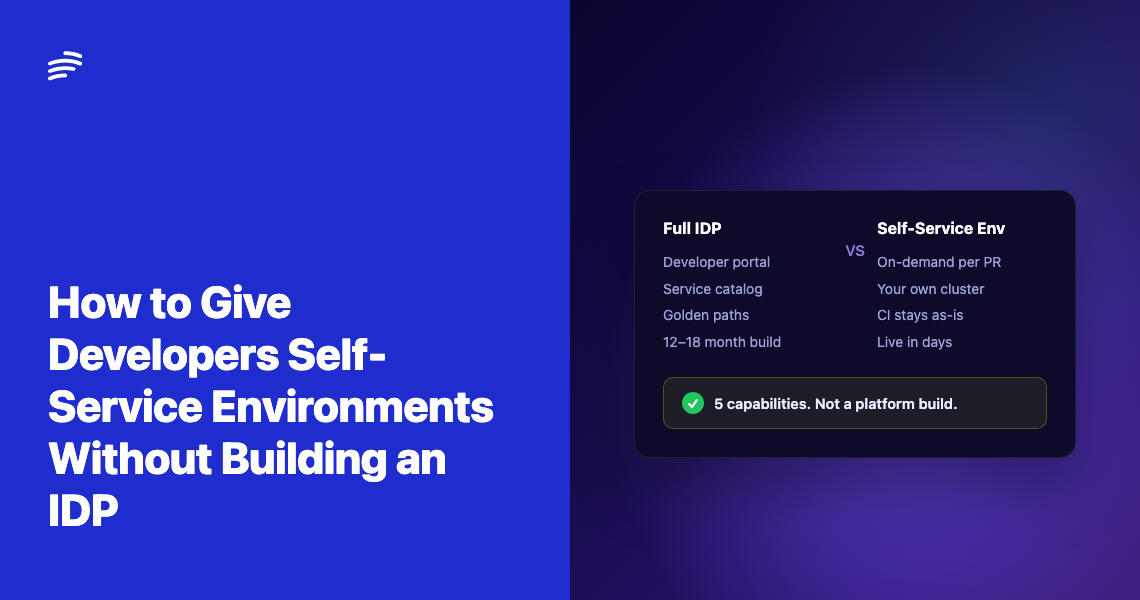
- CI stays exactly as it is. The fix here is deployment/validation infrastructure, not a rewrite of your build pipeline — see how to give developers self-service environments without building an IDP for the mechanics of adding this without migrating CI.
- Bigger, riskier AI-authored diffs get the same full-stack validation as anything else — instead of being waved through faster because the queue is backed up, which is exactly the failure mode the GitHub Agent PR study surfaced.
Give Every AI-Generated PR Its Own Environment
Bunnyshell spins up a full-stack, isolated environment for every pull request automatically — so validation scales with PR volume instead of queueing for shared staging.
How to Tell If Your Team Already Has This Problem
Most teams don't notice this bottleneck until someone measures the right thing. Three checks that take under an hour and tell you where you stand:
- Compare time-to-open-PR against time-from-PR-to-merge, over the last quarter. If the first is flat or dropping while the second is climbing, you have this exact problem, whether or not anyone's named it yet — this is the same divergence Opsera found at 250,000-developer scale.
- Check staging environment utilization during your busiest 2-3 hours of the day. If it's regularly near 100% with a visible queue, you're already paying the compounding cost described above, and it will only get worse as AI-assisted PR volume grows.
- Track the gap between PRs merged per day and features actually reaching production stable per week. A widening gap here is the clearest sign that something downstream of "merge" — deployment, staging verification, rollback cycles — is absorbing the throughput gains before they reach users.
What to Actually Do This Quarter
- Measure your real review-to-merge time, not just time-to-open-PR. If time-to-PR is dropping while review time is climbing, you have this exact problem.
- Check how many PRs are contending for your staging environment on a busy day. If it's more than a handful, you already have a queueing problem that will only get worse as AI-assisted PR volume grows.
- Separate "AI wrote this faster" from "this shipped faster." LinearB's 39-point gap between perceived and actual velocity exists because most teams are measuring the wrong end of the pipeline.
- Give large, AI-authored diffs the same (or stronger) validation as anything else — don't let a backed-up review queue quietly lower the bar for the riskiest changes.
- Fix the environment bottleneck before trying to fix review quality. You can't meaningfully improve review judgment while reviewers are also fighting for a shared staging slot — solve the queueing problem first, then invest in review process second.
The Takeaway
AI coding tools delivered on the promise of faster code generation — 42% of commits, 60 million Copilot reviews, real throughput gains in the data. What they didn't do, and were never going to do on their own, is scale the validation infrastructure underneath them. The teams seeing the LinearB gap — feeling faster while actually shipping slower — are the ones who scaled code generation without scaling the thing that has to catch up to it: environments to validate against, in parallel, at the volume AI tools now produce.
That's an infrastructure problem, not a people problem. It's solvable without slowing AI down and without hiring your way out of it — and unlike the review-quality half of this problem, it's the half you can fix this quarter.
Stop Queueing for Staging
Every pull request gets a real, full-stack environment automatically — human-authored or AI-authored, one PR or fifty in parallel.