Best QA Automation Tools for Small Teams in 2026
Why This List Is Shorter Than Most
Most "best QA automation tools" roundups list 15-20 tools across every category: browser testing, API testing, visual regression, load testing, accessibility, mobile. A 5-20 person team doesn't need all of that on day one, and trying to adopt it all at once is how QA automation initiatives stall before they ship anything.
This list covers what actually matters for a small team's first real QA automation setup: one browser testing tool, one API testing tool, and the CI/environment layer that makes both of them trustworthy.
Elena took over QA tooling at an 11-person logtech startup after the previous setup — a mix of five different tools nobody fully understood — had quietly stopped running months earlier. She replaced all of it with just Playwright and Postman, wired into the CI they already had. Coverage on the critical paths went from "unknown, probably broken" to verified on every PR within three weeks.
Playwright: Browser E2E Testing
What it does: Automates real browser interactions — clicking, typing, navigating — and asserts on what actually renders. Runs against Chromium, Firefox, and WebKit from one test file.
Why it's the pick for most small teams: Auto-waiting eliminates the flaky sleep() calls that plague hand-rolled Selenium setups. Built-in parallelization means a 50-test suite doesn't take 50x as long as a single test. Free and open source. Full framework comparison (Playwright vs Cypress vs Selenium) in our E2E testing tools guide.
Realistic setup time: A team with zero existing E2E coverage can usually get 5-10 smoke tests running on real PRs within a day, covering signup, login, and whatever the core workflow is.
See how API tests run against isolated per-PR environments.
Explore preview environments built for exactly this workflow.
Postman / Newman: API Testing
What it does: Postman is the interactive tool for building and testing API requests; Newman is its CLI runner, built specifically to run Postman collections inside CI.
Why it matters for small teams: Most bugs in a backend-heavy product show up at the API layer before they show up in the UI. A small API test suite, run via Newman on every PR, catches broken contracts and regressions faster than waiting for a browser test to fail three layers downstream. Full setup in our Postman/Newman API testing guide.
Realistic setup time: If you already use Postman for manual API testing (most backend teams do), exporting an existing collection and wiring it into CI via Newman takes an afternoon, not a project.
GitHub Actions or GitLab CI: Orchestration
What it does: Triggers your test suites automatically on PR events, and reports results back into the PR itself.
Why it's on this list: You almost certainly already have one of these. The QA automation setup doesn't need a new orchestration tool; it needs a job added to the pipeline you're already running.
The Part Most Lists Skip: The Environment Layer
Here's what a tools roundup usually leaves out: Playwright and Postman are only as reliable as what they're pointed at. Run either against a shared staging environment that three other PRs are also deploying to, and you'll get intermittent failures that have nothing to do with your test code.
Marek's team adopted Playwright with real enthusiasm, wrote 40 solid tests in the first month, and then watched trust in the suite collapse over the following two months as "flaky" failures piled up. The tests weren't flaky. The shared staging environment they ran against was getting overwritten by whichever PR deployed last, mid-test-run, roughly a third of the time. Once they moved to one isolated environment per PR, the same 40 tests started passing and failing for real reasons only.
This is why the environment layer belongs on a "best QA automation tools" list even though it's not a testing tool in the traditional sense. A per-PR environment platform doesn't replace Playwright or Postman — it makes both of them trustworthy.
Tools Worth Adding Later, Not First
Visual regression testing (Percy, Chromatic) catches unintended UI changes by comparing screenshots across builds. Genuinely useful, but it adds noise before your team has a stable baseline. Add it once your E2E and API suites are solid, not before.
Load testing (k6, Artillery) matters once you have real traffic patterns to test against. A 10-person team pre-launch usually has nothing meaningful to load-test yet — this is a post-launch tool, not a day-one one.
Accessibility testing (axe-core, Pa11y) deserves a place in most stacks eventually, and it's often cheap to add as a plugin to an existing Playwright suite once that suite exists. Bolting it onto a team with no E2E coverage yet just adds a second thing to configure before the first thing works.
The pattern across all three: they're valuable, and they're also the reason small teams stall out trying to adopt "QA automation" as one big initiative instead of Playwright this month, Postman next month, everything else once those two are actually running reliably.
What a Small Team's Stack Actually Looks Like
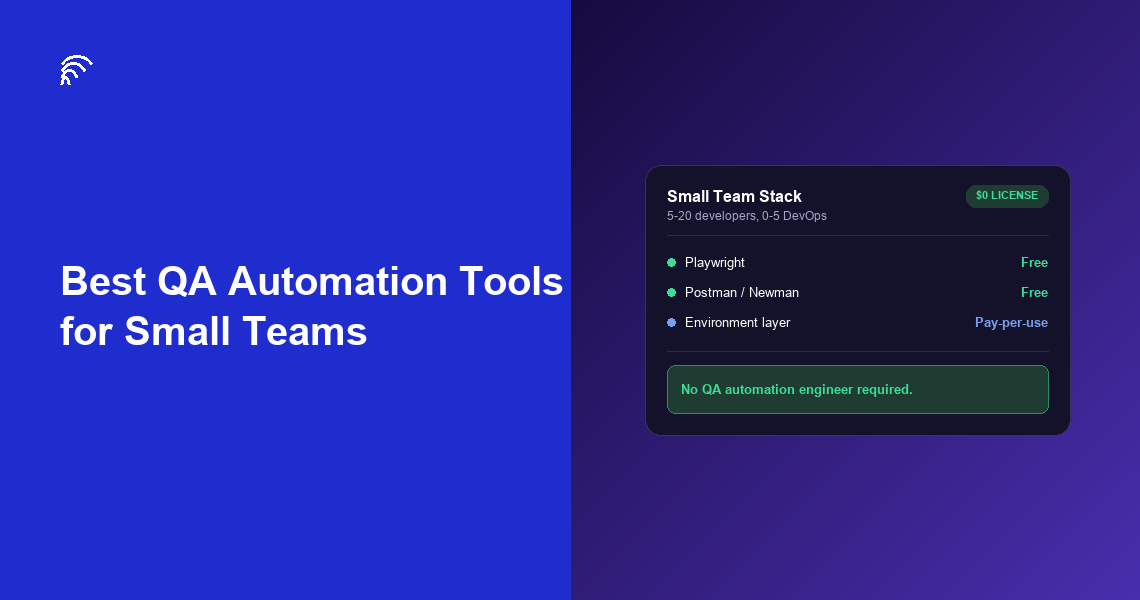
Put together, a realistic QA automation stack for a 5-20 person team in 2026:
| Layer | Tool | Cost |
|---|---|---|
| Browser E2E | Playwright | Free |
| API testing | Postman + Newman | Free |
| CI orchestration | GitHub Actions or GitLab CI | Free tier usually sufficient |
| Environment layer | EaaS platform (per-PR environments) | Pay-per-use, low hundreds/month at typical PR volume |
No dedicated QA automation engineer required. No tool in this stack costs a license fee at small-team scale. The only real spend is environment infrastructure, and that's cheaper than the alternative of a DevOps hire to build the same thing internally.
Getting Started Without Overbuilding
The mistake most small teams make with QA automation tooling isn't picking the wrong tool — it's picking too many tools too fast, or picking great tools and pointing them at an unreliable environment. Start with Playwright for the two or three workflows that would actually hurt if they broke, add Postman/Newman for your critical API endpoints, and make sure both are running against an environment that isn't shared with anyone else's in-flight changes.
That's a real QA automation setup, running on every pull request, with nobody on the team carrying a "QA automation engineer" title — see Bunnyshell for developers for what that self-service setup looks like day to day.
✅ Key Takeaways
- Tool choice matters less than most guides suggest — environment reliability matters more
- Playwright, Cypress, Postman, and GitHub Actions/GitLab CI are all free at the tier a 5-20 person team needs
- A test suite is only as trustworthy as what it runs against — a flaky shared staging box undermines any tool
- No tool on this list requires a dedicated QA automation engineer to configure and maintain
- Total tooling cost for most small teams: $0 in licenses, some CI minutes, and modest environment infrastructure
FAQ
What are the best QA automation tools for a small team in 2026?
Playwright for browser E2E testing, Postman/Newman for API testing, and GitHub Actions or GitLab CI for orchestration cover most of what a 5-20 person team needs. None of these require a dedicated QA automation engineer to set up.
Do QA automation tools work without a dedicated QA engineer?
Yes. Playwright, Cypress, and Postman are designed to be used by developers, not just QA specialists. A small team can write and maintain a reasonable test suite without a dedicated QA hire, especially if one or two people take ownership of it part-time.
What's the most important QA automation tool decision for a small team?
The testing framework (Playwright vs Cypress vs Selenium) usually matters less than the environment strategy. The best test suite in the world is only as reliable as what it's tested against; a flaky shared staging environment undermines any tool you pick.
How much do QA automation tools cost for a small team?
Playwright, Cypress, and Postman are all free and open source at the core tier. The real cost for a small team is usually CI minutes and environment infrastructure, not the testing tool license — which is why the environment layer matters as much as tool choice.
Start free, no credit card required.
Build this stack on your own repo — most teams have their first PR environment running the same day.