How to Test a Pull Request Before Merging
Reading Code Is Not the Same as Running It
A pull request — the merge request for a feature branch back into main — can look correct and still be wrong. Unit tests pass. The diff makes sense. A reviewer approves it. Then it merges, and something breaks that nobody caught, because nobody actually ran the full stack with that change in it.
This gap is why "test a pull request before merging" is a different question from "review a pull request before merging." Review checks whether the code looks right. Testing checks whether it behaves right — with the database, the other services, and any external calls all running together, not mocked.
Deepak reviewed a 40-line PR at a logistics startup that changed how order statuses synced between two services. The diff looked clean, the reviewer approved it in four minutes, and it merged. Two days later, a customer support ticket came in: orders were showing "delivered" a full day before the delivery service had actually confirmed it. The bug was a race condition between two services that only showed up when both were actually running — something no diff review or unit test would have caught. An E2E test against a real environment would have caught it in minutes.
The Setup: One Environment Per PR
The practical version of "test this PR before merging" needs three things in place before you ever open a pull request.
A trigger. When a PR opens, something needs to notice and start the process automatically. GitHub Actions, GitLab CI, or a webhook-based integration all work.
An environment definition. Your app, database, and dependencies need to be defined somewhere your CI can read — whether that's Docker Compose, Helm charts, or plain Kubernetes manifests. This doesn't change per PR; it's the same definition every time. See Preview Environments for CI/CD for how this ties into your existing pipeline.
A place for it to run. Something needs to actually provision the environment: spin up containers or pods, wire up networking, expose a URL. This is the part that used to require a DevOps engineer's ongoing attention. On a managed Environments-as-a-Service platform, it's automatic.
Once those three pieces exist, the workflow on every PR looks the same:
- Developer opens a PR
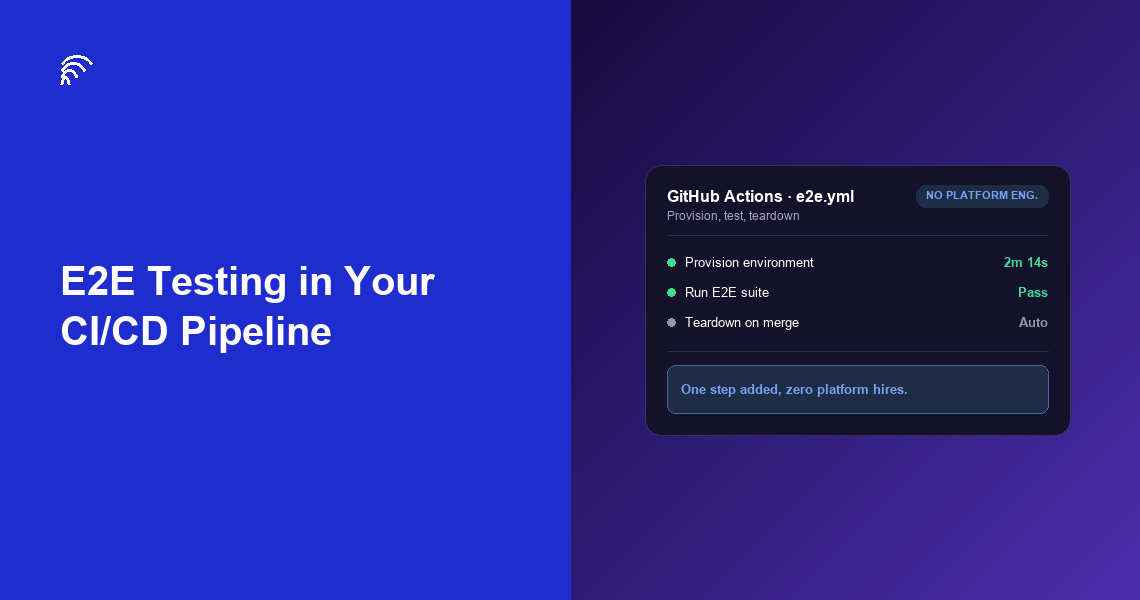
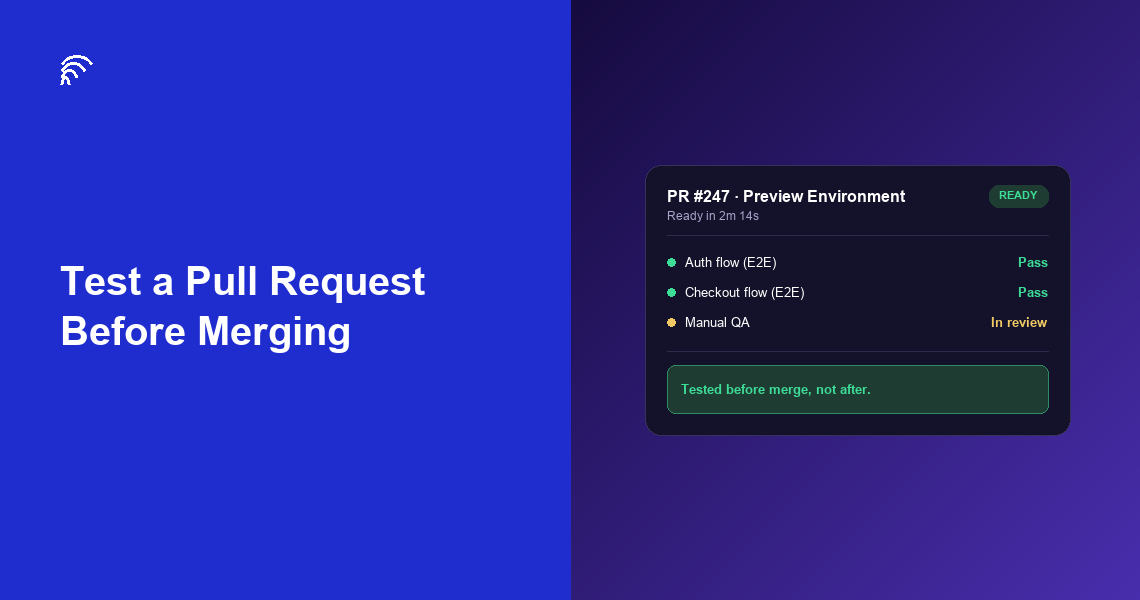
- Environment provisions automatically from the existing config — no manual step
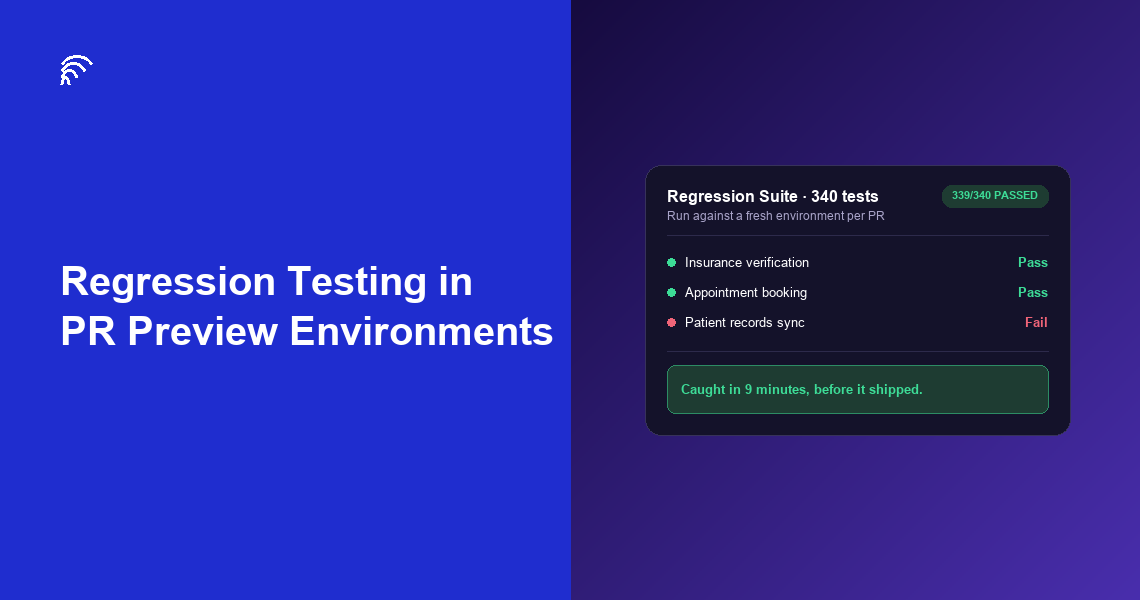
- Automated E2E suite runs against the fresh environment
- Results post back to the PR (pass/fail, visible in the GitHub/GitLab UI)
- Anyone can also open the environment's preview URL and click through manually
- PR merges → environment tears down automatically
See this running against your own stack.
Most teams have their first PR triggering a real environment the same day.
What Actually Gets Tested (and by Whom)
Two things happen against the same environment, usually in parallel.
Automated E2E tests run whatever suite you already have — Playwright, Cypress, Selenium, whatever the team picked before any of this (see our E2E testing frameworks comparison if you haven't). The only change from running against localhost or shared staging is the base URL the tests point at.
Manual QA happens on the exact same deployed instance, via a shareable preview URL. A QA engineer, the PR author, or a product manager can click through the actual feature — not a mockup — before approving. Because the environment is scoped to that one PR, nobody else's changes can interfere with what's being tested.
Sofia managed QA for a 9-person e-commerce team in Lisbon. Before switching to per-PR environments, testing a checkout flow change meant booking a slot on the shared staging server, usually a day out, then hoping nobody else deployed something that broke it mid-test. After the switch, every PR arrived with its own live URL. She tested the moment a PR was ready, not whenever staging happened to be free. Her team's average time from "PR opened" to "verified and mergeable" went from a day and a half to under three hours.
Sylius, the open-source e-commerce platform behind a 6,500-person community, hit the same wall at larger scale — retiring a self-maintained demo instance in favor of automatic environments for every pull request and branch.
Wiring It Into GitHub Actions or GitLab CI
You don't need to rebuild your CI pipeline to add this. Most teams bolt it onto whatever they already run.
In GitHub Actions, a pull_request trigger fires on open, and a step calls the environment provisioning API (or CLI) before your existing test job runs. The test job's config just needs the environment's URL, usually passed as an output from the provisioning step to an environment variable the test runner reads.
In GitLab CI, the same pattern works with a merge_request pipeline trigger. One job provisions the environment and exposes its URL as an artifact or variable; the next job in the pipeline consumes it.
Either way, you're not replacing your CI. You're adding one step before the tests run, and one cleanup step after the PR closes. If you're not sure where to start, check whether your CI provider already has a marketplace action or integration for this — most of the major EaaS platforms publish one.
Handling the Edge Cases
Multi-service changes. If a PR touches more than one repository or service, the environment needs to reflect that — pulling in the other services at their current main-branch state (or a pinned version) alongside the PR's changed service. This is a configuration detail, not a blocker, but it's worth checking your setup handles multi-repo PRs specifically if your architecture is service-oriented.
Database state. Tests need realistic data to be meaningful. Seed the environment with a known dataset — either a sanitized production snapshot or a fixture set — so results are reproducible instead of depending on whatever state a shared environment happened to be in.
Flaky results. A test that fails once against a fresh environment might be a real bug or might be flaky. Re-run it two or three times against the same fresh environment before deciding which. This is cheap to do when environments are disposable and expensive to do against a shared, booked staging slot, which is part of why flaky-test triage tends to get skipped on shared infrastructure.
Why This Matters More With AI-Assisted Development
Teams using Cursor, Copilot, or Claude Code open more PRs per week than they used to. AI-generated code tends to pass whatever unit tests exist — often written by the same tool, validating what the function was told to do rather than what the rest of the system actually expects from it.
Cross-service assumptions only surface when the full stack runs together, which is exactly what testing a PR against a real environment checks and a diff review structurally cannot. Higher PR volume without a corresponding testing setup just means more unverified code sitting in the queue. For teams without a dedicated DevOps hire to build this, see QA automation without a DevOps engineer.
✅ Key Takeaways
- Reading a diff tells you the code looks right; running it tells you the code works — most teams skip the second check until something breaks in production
- The fastest setup: one isolated environment per PR, created automatically on open, destroyed on merge
- Automated E2E tests and manual QA can both point at the same environment — no separate staging step needed
- Teams without this setup average multi-day delays between "code complete" and "actually verified"
- The whole flow, from PR open to environment ready, typically takes minutes, not hours
FAQ
How do you test a pull request before merging without a staging server?
Provision an isolated, full-stack environment per pull request instead of sharing one staging server. The environment spins up automatically on PR open from your existing Docker Compose, Helm, or manifest files, and gets a unique URL. Automated tests and manual QA both run against that URL, then the environment is destroyed on merge.
Can you test a pull request locally instead of deploying it?
You can, for changes that don't touch other services, external APIs, or infrastructure config. Local testing misses integration issues that only appear when the full stack runs together — which is most of what breaks in production despite passing locally.
What's the difference between testing a PR and reviewing a PR?
Reviewing a PR means reading the diff and judging whether the code looks correct. Testing a PR means actually running it — automated tests, manual clicking, or both — against a real deployed instance. Code that reads correctly can still behave incorrectly once every service is running together.
Do you need a QA engineer to test pull requests before merging?
No. Any developer can test a PR manually against a preview URL, and automated E2E tests run the same way regardless of who's on the team. A dedicated QA engineer adds systematic test design and coverage strategy, which helps at scale, but isn't required to start testing PRs properly.
How long should it take to test a pull request before merging?
With an isolated preview environment already provisioning automatically, the environment itself is typically ready in under a few minutes. Automated E2E test runtime depends on suite size, from under a minute for a small smoke suite to 10-20 minutes for a full regression pass. Manual QA time depends on the feature, but testers aren't waiting for a shared environment to free up.
Stop finding out about bugs from customer support tickets.
Give every pull request a real environment to test against — automatic, isolated, destroyed on merge.