QA Automation Without a Dedicated DevOps Engineer
Search "how to set up QA automation" and most guides jump straight to Kubernetes namespaces, Helm charts, and CI/CD pipeline architecture. That's not because QA automation inherently requires deep infrastructure work — it's because most guides assume you're building the environment layer from scratch.
Why "QA Automation" Usually Means "Hire a DevOps Engineer" — and Why That's Backwards
Building it from scratch is where the DevOps hire comes in. Someone has to provision environments, isolate them so parallel test runs don't collide, tear them down when done, and keep the whole thing from drifting out of sync with production. That's a real, ongoing job. It's also a job you can rent instead of staff.
Marius led engineering at a 14-person fintech startup in Cluj. By month eight, his team was merging 25-30 PRs a week. QA still meant deploying to one shared staging server, and whoever finished first got to test — everyone else waited or tested against stale code.
He posted a DevOps job listing. Quotes came back around $9,500/month fully loaded for a mid-level hire, and he shelved it. Three weeks later he found an Environments-as-a-Service platform instead, wired their existing Playwright suite to spin up against a fresh environment per PR, and never filled that req.
See what QA automation looks like when the environment layer isn't your problem.
Full-stack, isolated preview environments per pull request — automatic, no Kubernetes cluster to run yourself.
What Actually Needs a DevOps Engineer (and What Doesn't)
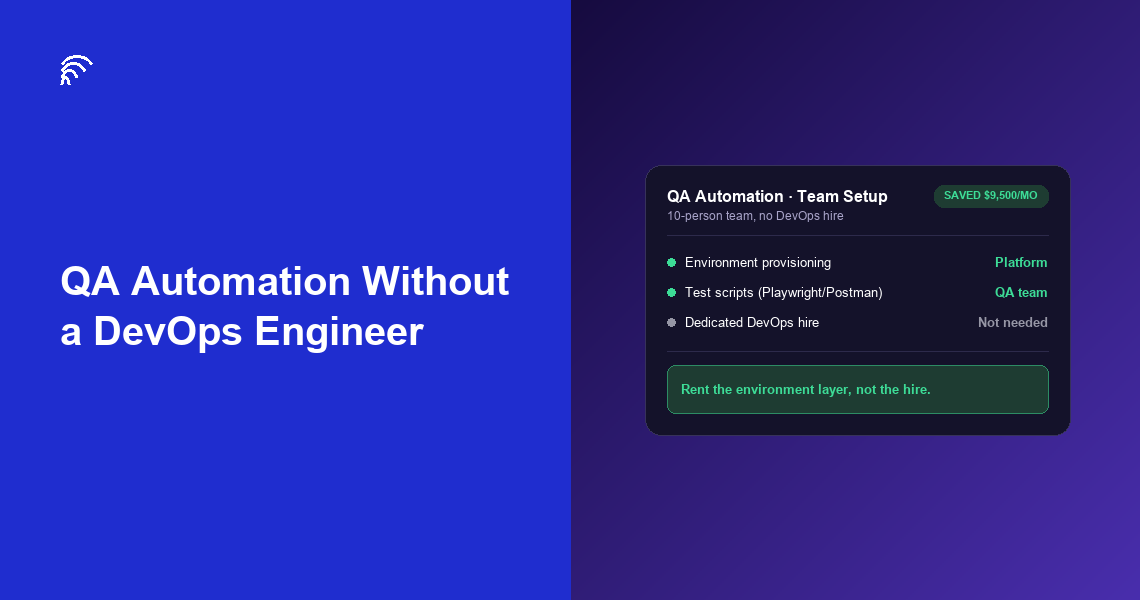
Split QA automation into two layers, because only one of them needs infrastructure expertise.
Layer 1: Test design and scripting. Deciding what to test, writing Playwright/Cypress/Postman scripts, maintaining assertions, triaging flaky tests. This is a QA or developer skill. It has nothing to do with Kubernetes — see Bunnyshell for developers for what self-service looks like from the engineer's side.
Layer 2: Environment provisioning. Getting a real, isolated, production-like environment for each test run to execute against. This is the DevOps-shaped problem — and it's the one that scales badly without either dedicated headcount or a platform built for it.
Most "how to do QA automation" content conflates the two, because historically you needed to solve both yourself. That's no longer true.
| Build it yourself | Rent the environment layer | |
|---|---|---|
| Who owns test scripts | QA/dev team | QA/dev team (unchanged) |
| Who owns environment provisioning | New DevOps hire | Platform |
| Time to first working setup | Weeks (cluster setup, CI wiring, debugging) | Hours to days |
| Ongoing maintenance | Someone's part-time job forever | Included |
| Monthly cost at 20-40 PRs | $8,000-$15,000+ (hire) | Low hundreds (pay-per-minute infra) |
The Setup: What Small Teams Actually Do
Step 1: Point your existing test suite at a real URL, not localhost. If you already have Playwright, Cypress, or Postman/Newman scripts running against localhost or a shared staging box, the only change is the base URL. The scripts don't change. See our E2E testing frameworks comparison if you haven't picked a framework yet, or the Postman/Newman API testing guide if your team tests at the API layer.
Step 2: Get one ephemeral environment per pull request, automatically. On PR open, a full-stack environment spins up — app, database, dependencies — from your existing Docker Compose, Helm, or manifest files. On merge or close, it tears down. No manual provisioning, no manual cleanup.
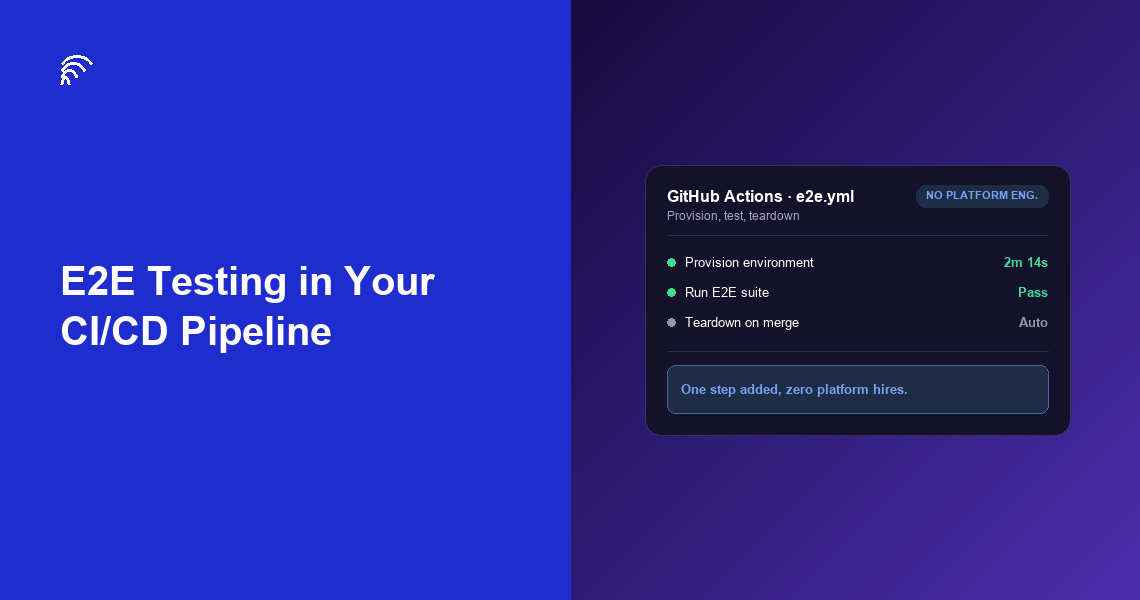
Step 3: Wire it into CI. GitHub Actions, GitLab CI, or whatever you already run triggers the environment creation, waits for it to be ready, runs the test suite against it, and reports pass/fail back to the PR.
Step 4: Let QA test manually too, on the same environment. The isolated environment isn't just for automated tests — a QA engineer (or anyone on the team) can open the same preview URL and click through the feature manually, on a real deployed instance, before it merges.
Priya ran QA solo for an 8-person edtech team in Austin. She used to block a shared staging slot two days in advance to manually verify a checkout flow change, then re-test it three more times because other PRs kept landing on the same environment mid-test. After switching to per-PR environments, she tested against a URL that belonged to that PR alone. Nobody else's code could touch it. Her average time-to-signoff on a feature dropped from a day and a half to about two hours.
The 10-15 Developer Threshold (and What Happens If You Ignore It)
There's a documented pattern across engineering teams: shared staging holds up fine below roughly 10-15 developers, then breaks down fast past it. Below that threshold, one shared environment and some informal "who's testing right now" coordination mostly works. Past it, PR volume outpaces what a single shared environment can hold without queuing, conflicts, or cross-contaminated test results.
This isn't a guess — it shows up consistently in postmortems and engineering blog posts about scaling pains, almost always phrased the same way: "worked fine until we hit [10-15] developers, then staging became the bottleneck."
Teams that ignore the threshold don't fail cleanly. They degrade slowly: QA cycles stretch from hours to days, "who broke staging" becomes a recurring Slack thread, and releases that used to ship weekly start slipping to every two or three weeks. None of it looks urgent on any single day. All of it compounds.
Handling AI-Generated Code in Your QA Automation
If your team uses Cursor, Copilot, or Claude Code, this problem arrives faster than the headcount math above suggests. AI-assisted developers open more PRs per week than they used to — the coding bottleneck moved to review and testing.
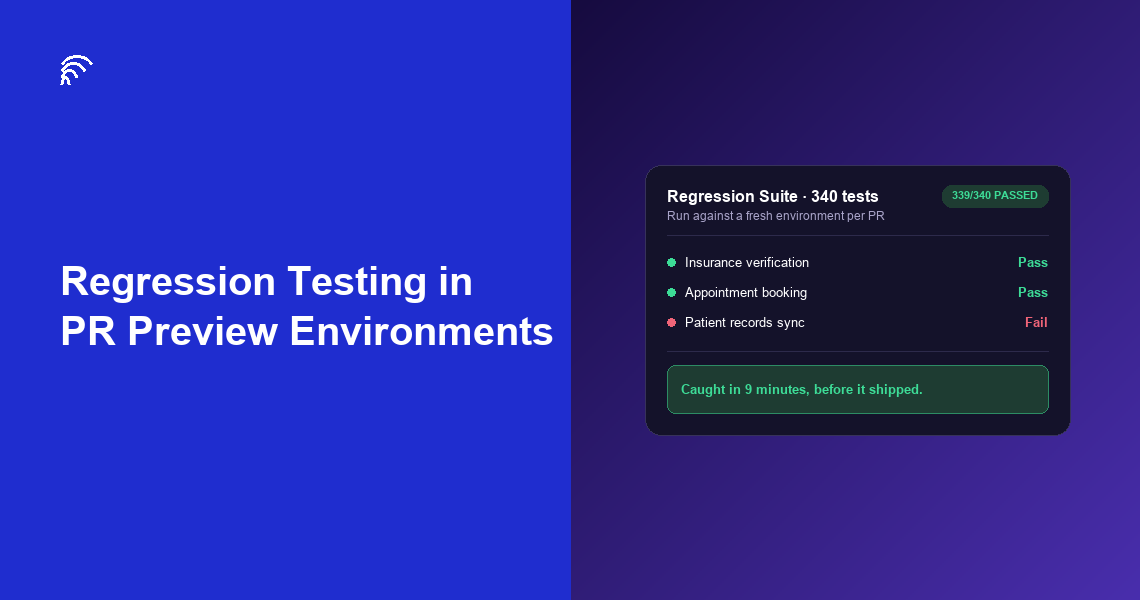
The failure mode is specific: AI-generated code tends to pass unit tests (written by the same tool, validating what the function was told to do) while missing cross-service assumptions that only show up when the full stack runs together. That's exactly what E2E testing catches and unit testing structurally can't.
A 12-person team running AI-assisted development at 2-3x their previous PR volume doesn't need a bigger QA team. It needs QA automation that scales with PR count without a linear increase in environment-management overhead — which is the same rented-environment-layer approach, just under more load. See our guide to end-to-end testing for how this fits into the broader E2E picture, or how Willow Wealth's ~20-person team made full-stack validation the default before every merge.
Flaky Tests Don't Disappear, They Just Get Cheaper to Catch
Renting the environment layer doesn't eliminate flaky tests. Async timing bugs and race conditions in application code are a code-quality problem, not an infrastructure one, and no environment fixes those.
What isolated per-PR environments do fix is the environmental flakiness: a test that fails only because another PR's deploy touched the shared staging box mid-run. That's roughly a third of documented flaky-test causes, and it goes away the moment every PR gets its own environment instead of a shared one.
The cheap way to catch what's left: run new or modified E2E tests a few times in a row against a fresh environment before merging. A test that fails even once across several fresh runs is flaky, full stop. That's only affordable when environments are disposable — against a shared, booked staging slot, running a test five times just to check for flakiness is not something anyone has time for.
Common Objections, Answered Directly
"We can build this ourselves with Terraform and some scripts." You can. Whether it's the right use of engineering time depends on whether infrastructure is your product. For a 10-person fintech or SaaS team, it almost never is — every week spent maintaining a homegrown environment pipeline is a week not spent on the product customers pay for.
"Isn't this expensive?" Compare it to the alternative, not to zero. A DevOps hire costs $8,000-$15,000+/month fully loaded. Pay-per-minute environment infrastructure for a 10-20 person team running 20-40 PRs a month typically runs in the low hundreds. The rented layer is cheaper than the hire in almost every small-team scenario.
"Do we need Kubernetes expertise?" Not with a managed platform. You define your stack once — Docker Compose, Helm charts, or raw manifests all work — and the platform handles cluster provisioning and namespace isolation underneath (see Kubernetes preview environments for how this works on your own cluster, or Environment as Code for the full YAML-based definition model). Kubernetes knowledge is only required if you're building this layer yourself.
✅ Key Takeaways
- The DevOps-heavy part of QA automation isn't writing tests — it's building and maintaining the environment layer, and that's the part you can rent instead of build
- Teams hit the wall around 10-15 developers, when PR volume outpaces a shared staging environment
- A rented environment layer costs a few hundred dollars a month; a DevOps hire costs $8,000-$15,000/month fully loaded
- Playwright, Cypress, or Postman scripts you already have work unchanged — point them at a real per-PR URL instead of localhost or shared staging
- The team that skips the DevOps hire doesn't skip QA rigor — they just buy the infrastructure piece and keep the testing piece in-house
FAQ
Can a 10-person engineering team do QA automation without hiring a DevOps engineer?
Yes. The DevOps-heavy part of QA automation is building and maintaining the environment layer — provisioning, isolating, and tearing down test environments. Renting that layer from an EaaS platform removes the one piece that actually needed a dedicated hire; the test-writing part (Playwright, Cypress scripts) is a QA or developer skill, not a DevOps one.
What is the minimum team size that needs a dedicated DevOps hire for QA automation?
There's no fixed number, but the pattern shows up consistently around 10-15 developers, when PR volume outpaces what a shared staging environment can hold without queuing or conflicts. Below that, a rented environment layer plus one engineer spending a few hours a month on CI maintenance is usually enough.
What's the difference between QA automation and test automation?
They're usually used interchangeably, but QA automation more specifically implies the process is owned by quality assurance as a discipline — test design, coverage strategy, flakiness triage — while test automation can just mean scripting existing manual tests. In practice for a small team, one or two people wear both hats.
Do I need Kubernetes knowledge to set up QA automation with preview environments?
No, if you use a managed EaaS platform. You define your stack once, in Docker Compose, Helm, or plain manifests, and the platform handles cluster provisioning and namespace isolation. Kubernetes knowledge is only required if you're building the environment layer yourself.
How much does QA automation cost for a small team without a DevOps hire?
A DevOps hire alone runs $8,000-$15,000/month fully loaded in most markets. Renting the environment layer on a pay-per-minute EaaS platform for a 10-person team running 20-40 PRs a month typically costs a few hundred dollars a month in infrastructure, plus whatever time someone spends writing and maintaining the actual test scripts.
Deploy your first environment free.
No credit card required — most teams have a working setup the same day.